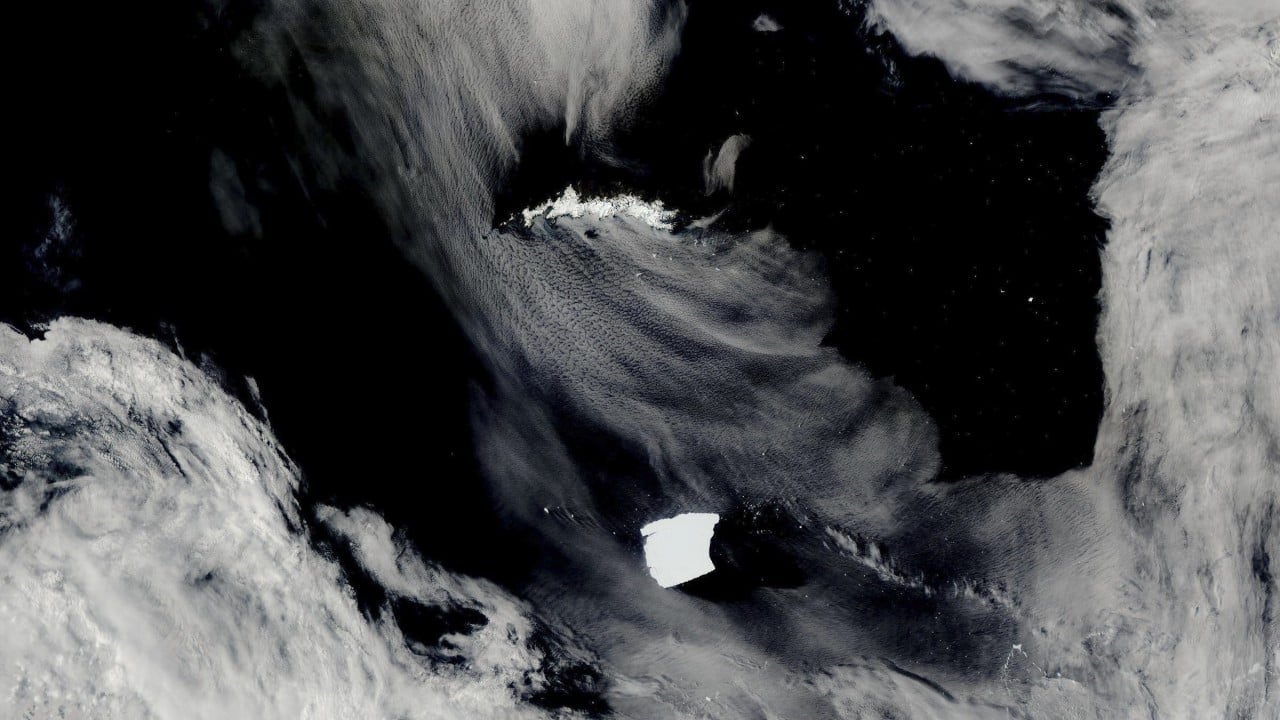
Icebergs do not dance. They do not sing. They do not whisper ancient secrets into the ears of climate scientists who have spent too long in the sun. An iceberg is a massive, drifting block of frozen freshwater that is structurally failing. When the media describes the "final dance" of a tabular berg like A23a, they aren't practicing science. They are practicing necropsy-themed performance art.
We have developed a pathological obsession with the aesthetics of collapse. We treat the erosion of the Antarctic ice shelf like a prestige drama, complete with character arcs for individual bergs and a mournful soundtrack of calving crunches. This obsession is more than just annoying. It is a massive distraction from the mechanical reality of planetary thermodynamics. We are staring at the sparks instead of the engine fire.
The Myth of the Messianic Iceberg
The current narrative suggests that by tracking a single iceberg’s journey through "Iceberg Alley," we can somehow "understand our future." This is a fundamental misunderstanding of scale and causality. A23a, for all its one-trillion-ton glory, is a statistical rounding error in the context of global sea-level rise. Tracking its demise is like watching a single ice cube melt in a swimming pool to determine when the water will get warm.
I have spent years looking at how data is weaponized to create "narrative impact." In the tech and climate space, we call this "The Hero’s Journey Fallacy." We pick a protagonist—in this case, a four-thousand-square-kilometer slab of ice—and imbue it with agency. We pretend its journey toward the South Orkney Islands is a tragic odyssey.
The reality is much more boring and much more dangerous. The iceberg isn't telling us a story. It is demonstrating a phase transition. $L = Q/m$. Latent heat doesn't care about your metaphors. When we romanticize the "death" of an iceberg, we distance ourselves from the systemic reality that the Southern Ocean is absorbing over 90% of the excess heat trapped by greenhouse gases. We are mourning the symptom while ignoring the infection.
Stop Asking if the Ice is Melting
"People Also Ask" sections are littered with questions like "How much will sea levels rise if A23a melts?"
The honest, brutal answer? Negligible.
A23a was already floating. Archimedes’ Principle dictates that because the ice was already displacing its weight in water, its melting has almost zero direct impact on sea levels. If you want to worry about sea-level rise, stop looking at the bergs already in the water. Start looking at the land-based glaciers in the Amundsen Bay that are losing their grip because the "cork" (the ice shelf) is thinning.
The obsession with "floating" ice is a failure of basic physics education. We focus on the spectacle of the break-off because it makes for a great satellite photo. We ignore the grounding line—the invisible point where the glacier leaves the bedrock and starts to float—because you can’t see it from a Cessna and it doesn't look like a "dance."
The E-E-A-T of Climate Voyeurism
I’ve seen organizations burn millions of dollars on "awareness" campaigns that involve flying influencers to the Arctic Circle to take selfies with melting bergs. It is the ultimate expression of the "awareness" trap. We act as if witnessing the destruction is a form of labor. It isn’t. It’s voyeurism.
True expertise in this field isn't about naming icebergs like they’re pets. It’s about understanding the Thermohaline Circulation. It’s about the fact that as these massive bergs melt, they dump trillions of gallons of freshwater into the salty Southern Ocean. This changes the water density, which can theoretically slow down the "conveyor belt" of global ocean currents.
But here is the contrarian truth: even that "doomsday" scenario is often overblown in the short term to secure grant funding or clicks. The ocean is vast. The mixing timescales are enormous. By the time the "final dance" of a berg actually disrupts the Atlantic Meridional Overturning Circulation (AMOC), your coastal city will have already been underwater for fifty years due to thermal expansion—a process that is far less photogenic but far more certain.
The Problem with Forensic Science as Policy
The competitor piece argues that icebergs tell a story about our past. They do. We can drill into ice cores and find trapped bubbles of atmosphere from 800,000 years ago. This is invaluable data.
However, we are using this "forensic" approach to delay "preventative" action. We are so busy reading the "story" of the past that we’ve turned climate change into a historical research project rather than an engineering challenge.
- The Forensic Mindset: "Let's study the isotopic composition of this meltwater to see how the Eemian period ended."
- The Engineering Mindset: "We need to scale Carbon Capture and Storage (CCS) and nuclear baseload power yesterday."
We are choosing the forensic mindset because it’s poetic. It allows for long-form essays and "meditative" documentaries. Engineering is hard, expensive, and politically divisive. It’s much easier to write about the "poignant beauty" of a disappearing glacier than it is to build a high-voltage direct current (HVDC) grid.
The Actionable Pivot: Stop Watching, Start Building
If you actually want to impact the fate of the Antarctic ice sheet, stop reading articles about icebergs. The "story" they are telling is always the same: "It’s getting hot." We know.
Here is the unconventional advice for those who actually want to move the needle:
- Demand Hard Infrastructure over Symbolic Gestures: If a politician talks about "the beauty of the North," ignore them. Ask them about their stance on permitting reform for geothermal energy.
- Follow the Grounding Line, Not the Iceberg: Shift your attention to sub-glacial hydrology. The water moving under the ice on land is what determines our fate, not the ice currently floating in the sea.
- Acknowledge the Trade-offs: Every "green" solution has a scar. To save the ice, we need lithium, cobalt, and copper. This means mining. If you love the ice but hate the mine, you don't actually love the ice; you love the idea of a pristine world that no longer exists.
The Aesthetic Trap
We have romanticized the end of the world. We've turned the cryosphere into a museum of our own failures, and we’re charging admission via "climate tourism." Every time we frame a massive geophysical collapse as a "final dance," we are soft-pedaling the catastrophe.
A23a isn't dancing. It’s being liquidated. It is a massive asset of the Earth's cooling system being sold off for the price of our carbon-heavy lifestyle. There is no poetry in it. There is only the cold, hard math of energy imbalance.
Stop looking for stories in the ice. The ice doesn't have a story. It only has a melting point. $0^\circ\text{C}$ is not a suggestion; it’s a physical limit. When we hit it, the "dance" is over, and the bill comes due.
Stop mourning the ice and start hating the heat.