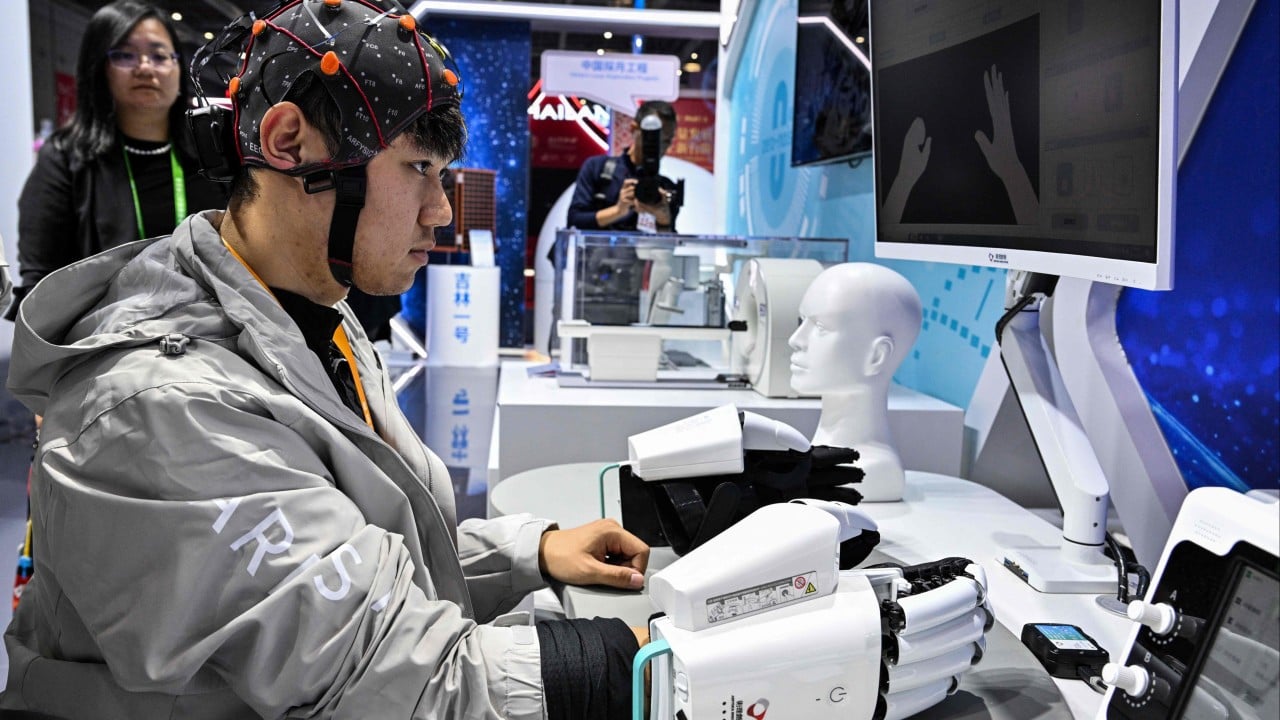
The approval of Neuracle’s NeuraLace system by China’s National Medical Products Administration (NMPA) marks the transition of high-bandwidth brain-computer interfaces (BCI) from experimental laboratory curiosities to regulated medical hardware. This is not a speculative milestone; it is a structural shift in the global neurotechnology supply chain. While Western discourse focuses on the high-profile narrative of Neuralink, the Chinese approach through Neuracle emphasizes a specific engineering philosophy: the minimization of surgical trauma through ultra-thin, flexible electrode arrays coupled with high-density channel counts. To understand the impact of this approval, one must analyze the mechanical constraints of neural integration, the data-throughput requirements of clinical BCIs, and the geopolitical implications of indigenous neuro-manufacturing.
The Triad of Neural Integration Constraints
Every implantable BCI must solve for three competing variables: signal fidelity, biocompatibility, and surgical viability. Neuracle’s NeuraLace targets the "Flexible Electronics" frontier, which addresses the primary failure mode of traditional rigid electrodes—the mechanical mismatch between the device and the soft tissue of the brain.
- Mechanical Impedance Matching: The human brain has a Young’s modulus (a measure of stiffness) of approximately $0.5$ to $1\text{ kPa}$. Traditional silicon-based Utah arrays or stainless steel electrodes are several orders of magnitude stiffer. This discrepancy leads to micromotion; as the brain shifts within the skull during respiration or cardiac cycles, rigid electrodes tear at the surrounding parenchyma.
- The Gliosis Feedback Loop: When the brain perceives a rigid foreign body, it initiates a neuroinflammatory response. Astrocytes and microglia encapsulate the electrode in a "glial scar." This scar acts as a biological insulator, increasing electrical impedance and distancing the sensor from active neurons.
- High-Density Spatial Resolution: To achieve meaningful control—such as moving a robotic limb with multiple degrees of freedom—the system requires high spatial resolution. This necessitates a high number of channels (electrodes) packed into a small surface area without increasing the total volume of the implant to a degree that causes significant displacement of brain tissue.
Decoding the NeuraLace Engineering Specification
The NeuraLace system differentiates itself through the use of polyimide-based thin-film substrates. By reducing the thickness of the electrode array to the micron level, Neuracle achieves a "silk-like" flexibility that allows the device to conform to the curvilinear morphology of the cerebral cortex. This reduces the chronic inflammatory response, theoretically extending the functional lifespan of the implant from months to years.
The technical superiority of this approach is quantified by the Signal-to-Noise Ratio (SNR). In a rigid system, the SNR decays over time as the glial scar thickens. In a flexible system like NeuraLace, the electrode maintains closer proximity to the neuronal cell bodies ($10-50\text{ }\mu\text{m}$), allowing for the detection of "spikes"—individual action potentials—rather than just the blurred aggregate of Local Field Potentials (LFPs).
The Data Bottleneck: From Analog Spikes to Digital Intent
The hardware is only the first half of the equation. The second half is the "Neural Decoder." Once the NeuraLace captures raw electrical fluctuations, the signal must be processed through a multi-stage pipeline:
- Amplification and Filtering: Raw neural signals are in the microvolt range ($10-500\text{ }\mu\text{V}$). They must be amplified and filtered to remove artifacts such as 50/60 Hz power line noise and electromyographic (EMG) interference from scalp muscles.
- Feature Extraction: The system identifies specific patterns in the firing rates of populations of neurons. This often involves Principal Component Analysis (PCA) to reduce the dimensionality of the data, focusing only on the signals that correlate with intended movement.
- Translation Mapping: Machine learning models, typically Recurrent Neural Networks (RNNs) or Transformers, map these neural patterns to specific outputs, such as moving a cursor on a screen or articulating a prosthetic hand.
The NMPA approval indicates that Neuracle has demonstrated not just that their hardware can survive in the brain, but that their software can reliably interpret these signals in a clinical environment with a low error rate. This involves rigorous testing of "Latency"—the delay between the user thinking and the device acting. For a BCI to feel intuitive, latency must remain below $100\text{ ms}$.
Geopolitical Asymmetry in Neurotechnology Standards
China’s acceleration in BCI approval reflects a broader strategy of "Standards Competition." By being the first to move these devices into a formal clinical regulatory framework, the NMPA is setting the baseline for safety and efficacy metrics that other regional regulators (like the FDA or EMA) will eventually have to reference.
This creates a distinct advantage in Clinical Data Aggregation. While Western firms are often slowed by fragmented healthcare systems and ultra-conservative trial phases, the centralized nature of Chinese medical research allows for rapid recruitment and standardized data collection across multiple Tier-1 hospitals. The volume of neural data generated by these early adopters will serve as the training set for the next generation of AI decoders, creating a "data moat" that is difficult for competitors to bridge.
The Risk Profile of Invasive BCI Deployment
It is critical to acknowledge that "implantable" remains synonymous with "high-risk." Despite the flexibility of the NeuraLace, any surgery involving a craniotomy carries the risk of infection, intracranial hemorrhage, and seizure activity.
The long-term stability of the polymer substrate is also a known engineering hurdle. While polyimide is biocompatible, the saline environment of the brain is chemically aggressive. Hydrolysis—the chemical breakdown of the polymer due to water exposure—can eventually lead to insulation failure and short-circuiting of the electrodes. Neuracle’s approval suggests they have addressed these concerns through advanced encapsulation techniques, likely using atomic layer deposition (ALD) of ceramics like Alumina or Zirconia to create a hermetic seal around the electronics.
Strategic Resource Allocation for Neurotech Entities
For organizations looking to compete or collaborate in this space, the focus must shift from "more channels" to "better integration." The industry is approaching a point of diminishing returns on raw electrode counts. The next phase of value creation lies in three specific domains:
- On-Chip Processing: Moving the neural decoding from an external computer to an Application-Specific Integrated Circuit (ASIC) located on the implant itself. This reduces the need for high-bandwidth wireless transmission, which is power-intensive and generates heat that can damage brain tissue.
- Power Autonomy: Solving the "Inductive Charging" problem. Most current BCIs require a bulky external coil to be placed over the implant site to provide power. Developing long-term, high-energy-density biocompatible batteries or more efficient transcutaneous power transfer is a prerequisite for 24/7 usability.
- Closed-Loop Modulation: Transitioning from "read-only" systems (moving a mouse) to "read-write" systems. This involves the BCI not only sensing brain activity but also providing sensory feedback (proprioception) by stimulating the somatosensory cortex. This would allow a patient to "feel" the grip strength of a robotic hand.
The NMPA approval of Neuracle’s NeuraLace is the opening salvo in a decade that will be defined by the "Internalization of Hardware." As we move away from external wearables and toward integrated neural lace architectures, the definition of a "medical device" will expand to include any system that mediates human cognition.
The strategic imperative for global stakeholders is to move beyond the fascination with the surgical feat and begin building the infrastructure for the "Neural Internet"—the protocols, security standards, and ethical frameworks that will govern the flow of data directly from the human motor cortex to the digital world. The success of Neuracle is a signal that the infrastructure is no longer theoretical; it is being manufactured, approved, and implanted today.
Establish a dedicated regulatory liaison office in Beijing to monitor the NMPA’s evolving BCI safety standards, as these will likely form the basis for the first international ISO standards for high-bandwidth neural interfaces. Simultaneously, prioritize the development of "decoder-agnostic" hardware interfaces to ensure that as AI models for neural translation improve, the physical implant does not become a legacy bottleneck.