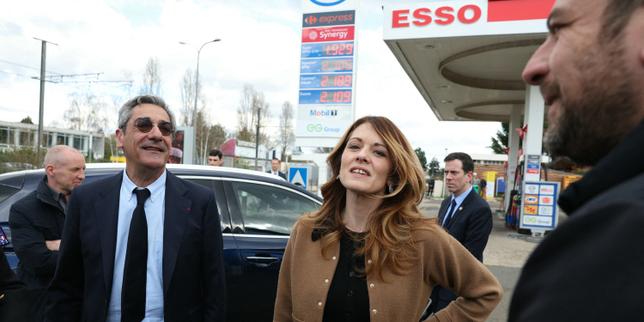
The French government’s inability to mitigate rising fuel prices is not a matter of political willpower but a structural entrapment defined by debt-to-GDP ratios and the rigid mechanics of the European Union’s Stability and Growth Pact. When global Brent crude prices surge, the standard populist demand is a reduction in the Taxe Intérieure de Consommation sur les Produits Énergétiques (TICPE). However, the French state currently operates under a deficit exceeding 5% of GDP, meaning any meaningful reduction in fuel taxes would require an immediate, corresponding cut in public services or an increase in sovereign borrowing that the markets—and the European Central Bank—are increasingly unwilling to subsidize.
The Trilemma of Energy Intervention
To understand why the "fiscal shield" (bouclier tarifaire) cannot be infinitely extended, we must examine the interaction between three competing forces that dictate French energy policy.
- Revenue Dependency: Fuel taxes are the fourth largest source of revenue for the French state. In a typical fiscal year, the TICPE generates approximately €30 billion.
- Social Stability: Energy costs act as a regressive tax, disproportionately affecting rural and peri-urban populations who lack access to the dense public transit networks of Paris or Lyon.
- Decarbonization Targets: Lowering the price of fossil fuels via subsidies creates a "rebound effect" that contradicts the European Green Deal and France’s own Stratégie Nationale Bas-Carbone (SNBC).
This trilemma ensures that any move to alleviate short-term pain for motorists exacerbates long-term structural debt or fails environmental mandates.
The Cost Function of a Fuel Rebate
A common misconception is that the state "profits" from rising pump prices through Value Added Tax (VAT). While the 20% VAT applies to the total price, the TICPE is a fixed volume tax, not a percentage of the price. If consumption drops because prices are too high, the state actually sees a net decrease in TICPE revenue.
The fiscal cost of a "simple" 10-cent reduction at the pump is roughly €5 billion per year. To fund this without increasing the deficit, the government would have to find equivalent savings in the national budget. Given that the largest expenditure blocks—social security, education, and defense—are legally or politically protected, the "margin of maneuver" disappears.
The Elasticity Gap
The effectiveness of price interventions is further limited by the price elasticity of demand for fuel in France.
- Commuter Inelasticity: Roughly 70% of French workers use their cars to reach their workplace. For these individuals, demand is almost perfectly inelastic in the short term; they must pay the price regardless of the cost.
- The Subsidy Leak: When the government subsidizes the price at the pump, a portion of that fiscal effort is captured by the refineries and distributors rather than the end consumer. Without strict price controls—which are illegal under EU competition law—the state essentially transfers taxpayer money to energy conglomerates' balance sheets.
Structural Bottlenecks in the Refining Sector
The price at the pump is not merely a reflection of crude oil costs and taxes; it is dictated by the "crack spread"—the difference between the price of crude and the price of refined products like diesel and gasoline.
France faces a specific vulnerability in its refining capacity. The country is a net importer of diesel. Even if the state were to eliminate all taxes, the price would still be subject to the global tightness in refining capacity. Europe’s shift away from Russian vacuum gas oil (VGO) and refined products following the invasion of Ukraine shifted the supply curve to the left. The result is a permanent premium on diesel prices that no domestic fiscal policy can fully offset.
The Debt Ceiling and Sovereign Risk
France’s debt currently exceeds €3 trillion. The interest payments on this debt (la charge de la dette) are now one of the largest items in the national budget.
If the government were to enact a massive, unfinanced fuel subsidy, the sovereign risk premium (the spread between French OATs and German Bunds) would likely widen. This increase in borrowing costs would eventually dwarf the "savings" provided to motorists. A 1% increase in interest rates costs the French treasury billions over the long term, creating a vicious cycle where subsidizing today's fuel leads to higher taxes tomorrow to service the resulting debt.
Targeted Aid vs. Universal Subsidies
The shift from the universal bouclier tarifaire to the indemnité carburant travailleurs (targeted aid for low-income workers) represents a move toward fiscal surgicality. Universal rebates are inefficient because they provide the same discount to a high-earning executive driving a luxury SUV as they do to a delivery driver on minimum wage.
However, targeted aid introduces a "threshold effect" (effet de seuil). Individuals earning just above the cutoff point face the full brunt of price increases with zero support, leading to perceived injustice and social friction. This creates a "squeezed middle" that lacks the protection of the state but bears the cost of its environmental and fiscal policies.
The Geopolitical Anchor
France's energy prices are tethered to the Euro/Dollar exchange rate. Because oil is traded in USD, a weak Euro acts as an invisible tax on French consumers. Even when Brent crude remains stable, a 5% depreciation of the Euro against the Dollar results in an immediate spike in import costs. The European Central Bank's mandate is inflation stability, not pump-price management. Consequently, the French government is a price-taker on the global stage, with no influence over the primary currency pair that determines its energy costs.
Logical Failure of Price Caps
Proposals to cap prices at a specific level (e.g., €1.99 per liter) rely on "voluntary" efforts by retailers like TotalEnergies. This is a fragile strategy.
- Supply Risk: If the market price exceeds the cap, retailers have no incentive to import or sell fuel at a loss, leading to potential shortages.
- Market Distortion: Small, independent gas stations—which account for a significant portion of the network in rural France—cannot afford to match the caps set by major integrated companies. This accelerates the desertification of rural fuel access.
Strategic Realignment
The only viable path forward involves a decoupling of individual mobility from fossil fuel volatility. This is not a matter of "lifestyle choices" but of infrastructure.
- Accelerated Depreciation for EVs: Instead of subsidizing the fuel (the opex), the state must accelerate the subsidization of the vehicle (the capex) for lower-income tiers.
- Energy Sovereignty via Nuclear: The long-term stabilization of the French economy depends on the Grand Carénage and the construction of new EPR reactors. Electricity-based mobility is the only way to insulate the French consumer from the OPEC+ supply-side shocks and the USD/EUR fluctuations.
The era of cheap, state-subsidized fossil fuels in France has reached its mathematical end. The government's lack of "maneuvering room" is a permanent feature of the new economic reality, not a temporary budgetary crunch. The strategic imperative shifts from managing the price of the liter to managing the transition of the kilometer. Any policy that attempts to fight the global price of oil with the French national budget is a battle against the laws of arithmetic.
The final strategic move for the administration is the redirection of the TICPE revenue into a "Transition Fund" that specifically finances the conversion of vehicle fleets in the most car-dependent regions, rather than attempting to blunt the price for all. This requires an admission that the age of the universal subsidy is dead, replaced by a regime of high-cost energy and hyper-targeted social support.