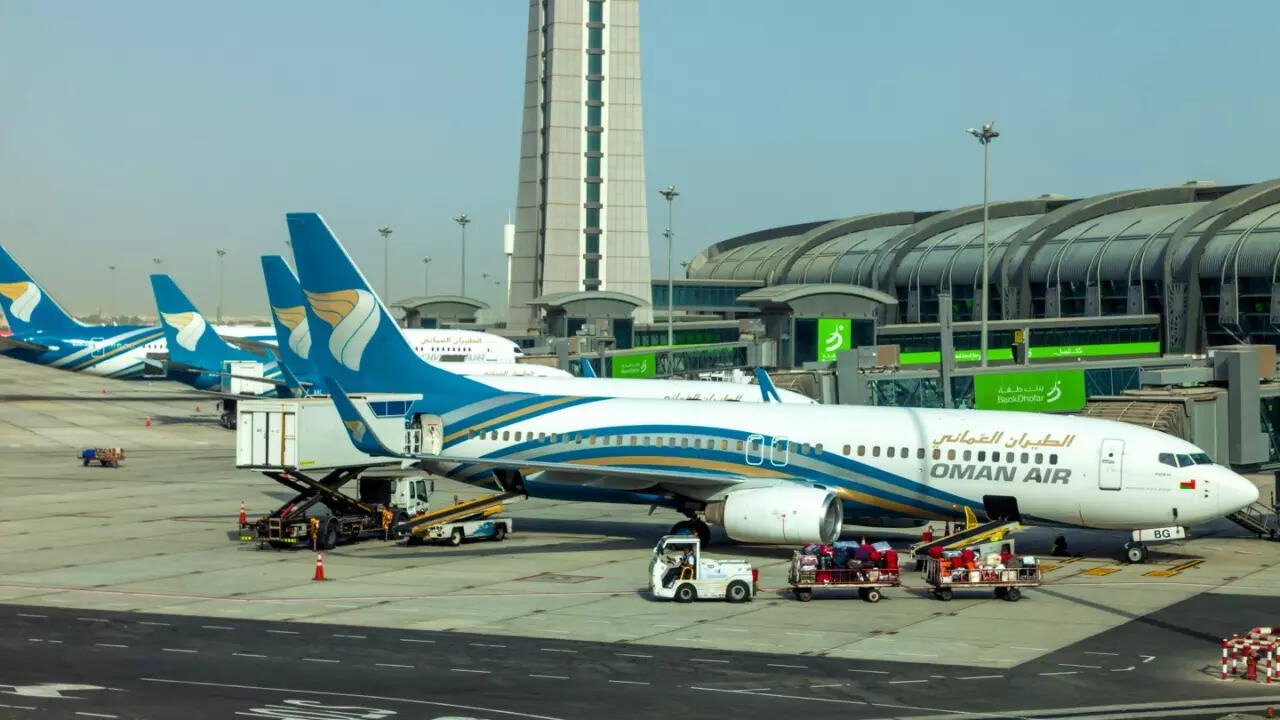
Oman Air has grounded a significant portion of its regional fleet through at least March 15, 2026, as the conflict between Iran and the US-Israel alliance shifts from a slow burn to an all-out aviation chokehold. While the airline frames these cancellations as a standard safety response to shifting airspace closures, the reality is far more complex. This isn't just about avoiding missiles. It is about an airline in the middle of a high-stakes financial restructuring being forced to navigate a literal war zone while its primary hub, Muscat, is transformed into a bottleneck for a region under fire.
The flight boards at Muscat International Airport tell a story of total regional paralysis. Destinations like Dubai, Doha, Bahrain, and Kuwait—the bread and butter of Gulf connectivity—have vanished from the schedule. International legs to Baghdad, Copenhagen, and even domestic hops to Khasab are gone. For the thousands of passengers currently stranded, the "safety first" narrative is cold comfort when the geopolitical map of the Middle East is being redrawn in real-time. Learn more on a similar issue: this related article.
The Geography of Risk
Since the escalation began on February 28, the central Middle East air corridor has effectively ceased to exist for civilian traffic. What remains is a frantic scramble to find a way around. Oman has found itself in the precarious position of being the "southern bypass." As carriers from Europe and Asia flee the airspace of Iran and Iraq, they are funneling through a narrow strip of Omani sky.
This increased traffic is not a windfall. It is a liability. On March 1 and March 3, drone strikes targeted the Port of Duqm. These weren't hypothetical threats. They were kinetic strikes on Omani soil that signaled a terrifying shift in the conflict's boundaries. When a drone hits a fuel tank in Duqm, the insurance premiums for every airframe sitting on a tarmac in Muscat or Salalah skyrocket. For an airline like Oman Air, which is fighting to reach financial break-even by 2027, these hidden costs are a hammer blow. Additional journalism by Reuters Business highlights similar perspectives on this issue.
Restructuring Under Fire
To understand why Oman Air is cutting these specific routes, you have to look at the balance sheet, not just the radar. Before the first missile was fired in this current cycle, CEO Con Korfiatis was already deep into a "right-sizing" mission. The airline recently shed 1,100 jobs and retired its entire fleet of Airbus A330s. They were moving away from the "transit hub" model perfected by Emirates and Qatar Airways, focusing instead on bringing tourists directly to Oman.
The war has effectively sabotaged that pivot. By cutting the "high-traffic" regional routes, the airline is attempting to preserve its limited resources—specifically its Boeing 737 MAX and 787 Dreamliner fleets—for long-haul rescue and repatriation missions. While flights to Kuwait are canceled, Oman Air is actually adding capacity to London, Istanbul, and Bangkok.
This is a strategic retreat. It is easier to justify the fuel and insurance costs of a 787 flying to Heathrow than it is to risk a 737 in the increasingly crowded and GPS-jammed skies over the Gulf. The airline is betting that it can weather the storm by serving as a bridge to the West while the regional house is on fire.
The GNSS Interference Factor
Beyond the visible threat of drones and missiles lies a subtler, more pervasive danger: GNSS interference. Pilots across the region have reported significant spoofing and jamming of navigation signals. When your flight computer thinks it is 50 miles away from its actual position, "business as usual" becomes impossible.
For a mid-sized carrier, the technical burden of navigating these electronic warfare zones is immense. Unlike the global giants who can absorb the delays of manual navigation and rerouting, Oman Air's leaner operation has less margin for error. Suspending regional flights isn't just about physical safety; it is about operational sanity. The complexity of managing a regional network in a jammed environment is "insane"—to use the CEO's own previous description of the airline's former fleet complexity.
The Fragility of the Tourism Pivot
The most damaging aspect of this crisis isn't the lost revenue from a week of canceled flights to Dubai. It is the long-term perception of Oman as a safe haven. The country has spent billions positioning itself as the "Switzerland of the Middle East," a neutral, peaceful destination for high-end travelers.
That brand is currently under siege. With the UK Foreign Office advising citizens to leave Salalah and drone activity reported near the southern coast, the "Visit Oman" campaign is facing a reality check. The airline had recorded record performance in 2025, with point-to-point traffic making up 64% of its passenger load. The goal was to reach a financial break-even point in record time. Now, those targets are likely being shredded in the boardrooms of Muscat.
The Cost of the Bypass
As Oman's airspace becomes a primary corridor for the "Egypt-Saudi-Oman southern bypass," the pressure on the ground is reaching a breaking point. Authorities have already restricted private jet traffic in Muscat to prioritize commercial and government flights. This is a clear indicator that the infrastructure is being pushed to its limit.
Airlines are taking longer routes to stay within the "safe" zones, which increases fuel consumption and crew hours. For Oman Air, which is in the middle of transitioning its fleet to more fuel-efficient models like the 737 MAX, these extra miles are eating the very savings they were supposed to generate. It is a cruel irony: the more efficient the fleet becomes, the more the war demands in extra fuel.
No Easy Way Out
The current advisory for Oman Air passengers runs through March 15, but nobody in the industry expects a return to normalcy by the 16th. The conflict between Iran and the US-Israel coalition is not a short-term flare-up. It is a fundamental shift in regional security.
Travelers are being told to "monitor the website" and "manage bookings online," but these are bureaucratic phrases for a situation that is essentially out of the airline's control. If you are holding a ticket to a regional Gulf destination, you are no longer a passenger; you are a data point in a geopolitical calculation.
The national carrier is doing what it must to survive—protecting its assets, streamlining its risk, and focusing on the few corridors that remain open. But as long as the skies over the Gulf are filled with more drones than Dreamliners, the "air travel shock" is only the beginning of a much longer, much more painful era for Omani aviation.
Check your flight status directly through the Oman Air mobile app before heading to the airport, as gate changes and last-minute cancellations are now the baseline, not the exception.