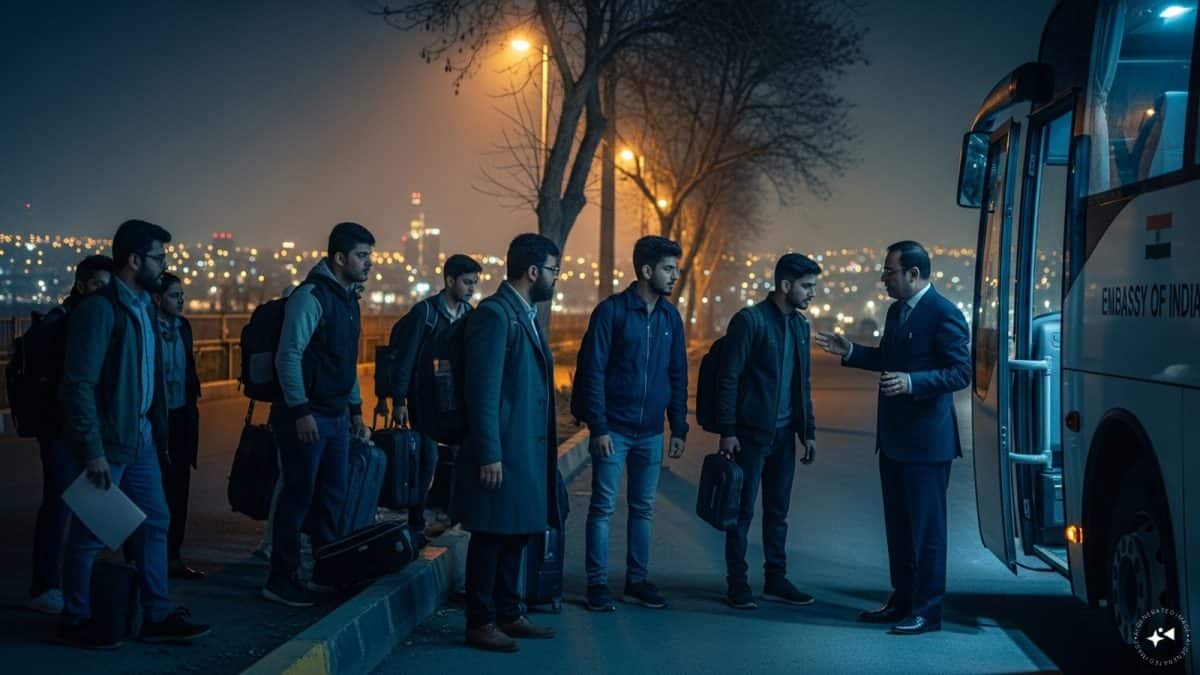
The mass relocation of Indian students from Tehran marks more than a logistics victory for South Block. It is a quiet admission that the regional stability India relied upon for its "Connect Central Asia" policy has fractured beyond immediate repair. While official narratives focus on the safety of the diaspora, the reality on the ground suggests a panicked scrambling of priorities as the shadow war between Israel and Iran moves into a direct, kinetic phase.
Moving hundreds of students across borders during a period of airspace closures and missile threats is not a routine consular exercise. It is an emergency extraction disguised as a precautionary measure. By pulling its youth out of the Iranian capital, New Delhi is signaling to the world—and to its own citizens—that the "wait and see" approach to the West Asia conflict has reached its expiration date.
The Logistics of a Quiet Retreat
The relocation effort was not a single, televised airlift. Instead, it functioned as a tiered withdrawal. Students enrolled at major institutions like the Tehran University of Medical Sciences were advised to leave in phases, utilizing commercial corridors before they tightened. Sources within the diplomatic community suggest that the Indian Embassy operated on a 48-hour intelligence window, constantly reassessing whether to trigger a full-scale evacuation or continue the piecemeal relocation.
The challenge wasn't just the missiles. It was the banking. Since the escalation, the Iranian Rial has faced renewed volatility, and the informal hawala channels that many students used to receive funds from home began to dry up. When a student cannot pay for bread or rent because the local economy is bracing for a strike on energy infrastructure, the "safety" of their dormitory becomes a secondary concern.
Why Tehran is No Longer the Safe Harbor
For years, Iran was the affordable alternative for Indian medical and Persian studies students. The tuition was manageable, the culture was familiar, and the geopolitical risk felt manageable. That calculation changed the moment the conflict moved from proxy battles in Lebanon and Yemen to direct ballistic exchanges between Isfahan and the Negev.
The Indian government has a history of successful evacuations—Operation Ganga in Ukraine and Operation Ajay in Israel—but Tehran presents a unique nightmare. Unlike Ukraine, where students could trek to various European borders, Iran is geographically isolated by political friction. To the west lies an unstable Iraq; to the east, a volatile Afghanistan and a complicated Pakistan. The only reliable exit is the air, and when the skies over the Persian Gulf turn into a combat zone, that exit closes.
The Hidden Cost to India's Regional Ambitions
Behind the humanitarian effort lies a crumbling foreign policy objective. India has invested billions in the Chabahar Port, envisioning it as a gateway to Russia and Central Asia that bypasses Pakistan. You cannot run a gateway when the host country is under constant threat of a decapitation strike on its command-of-control centers.
The relocation of students is a leading indicator of a broader "de-risking" strategy. If the environment is too dangerous for a 20-year-old medical student, it is certainly too dangerous for a long-term infrastructure project. This retreat creates a vacuum. As Indian influence recedes to prioritize safety, other actors—specifically China—are watching to see how much risk they can stomach in exchange for a tighter grip on Iranian energy and logistics.
The Problem with the Neutrality Doctrine
India prides itself on "strategic autonomy," the ability to talk to both Jerusalem and Tehran. This works during a cold war. It fails during a hot one. When India relocates its students, it is forced to acknowledge that its friendship with Israel provides no protection for its citizens in Iran. In fact, the closer New Delhi gets to the "I2U2" (India, Israel, UAE, USA) grouping, the more precarious the position of Indians in Tehran becomes.
There is a growing friction between the Ministry of External Affairs and the families of these students. Families want a guarantee of safety; the government can only offer a plane ticket. This disconnect highlights the fragility of the Indian diaspora’s presence in conflict zones. We treat them as "soft power" assets until the sirens go off, at which point they become liabilities that must be moved at any cost.
The Medical Degree Trap
A significant number of those relocated are medical students. This isn't just a travel story; it’s an education crisis. India’s domestic medical seat shortage drives thousands of middle-class students to places like Iran. When these students are pulled out, their education doesn't just pause—it often resets.
- Credit Transfers: Many Indian universities do not recognize partial semesters from Iranian institutions, leaving relocated students in a specialized kind of academic limbo.
- The Foreign Medical Graduate Examination (FMGE): Students returning from Iran already face a rigorous screening process to practice in India. Long-term displacement makes passing these exams nearly impossible.
- The Financial Void: Most families took out loans for these degrees. If the student is sitting in a living room in Delhi instead of a lab in Tehran, the interest on those loans continues to stack up while the degree remains out of reach.
The government has yet to provide a framework for these "returnees." Unlike the Ukraine crisis, where there was a massive public outcry to integrate students into Indian colleges, the Iran relocation is being handled with a quietness that borders on secrecy. This lack of transparency leaves students wondering if they are being protected or merely abandoned to a different kind of failure at home.
The Intelligence Failure of Anticipation
Why were so many students allowed to remain in Tehran as the rhetoric sharpened over the last six months? Investigative lookbacks at the 2024-2025 period show a series of "all is well" advisories that failed to account for the rapid shift in Israeli military doctrine regarding "the head of the snake."
India’s intelligence community underestimated the likelihood of a sustained, direct conflict. They viewed the region through a 20th-century lens of "proportionality." But the current conflict ignores those rules. When the rules of engagement vanish, the first casualty is the security of foreign nationals. The relocation is an admission that the baseline intelligence was wrong.
The Ripple Effect on the Diaspora
There are over 8 million Indians in the Gulf and West Asia. If Tehran is the first domino, the logistics of a wider regional evacuation are unthinkable. The move to pull students out of Tehran first is a "stress test" for a much larger, much more terrifying possibility.
If a full-scale war breaks out involving the regional heavyweights, the Indian Navy and Air Force do not have the capacity to move millions. They can move thousands. By starting with the students in Tehran, the government is narrowing the scope of its responsibility, focusing on the most vulnerable and the most "visible" demographic before the exits become too crowded.
Strategic Recalibration or Retreat
Every bus that leaves Tehran for the border or the airport is a testament to the fact that India’s West Asia policy is currently in a defensive crouch. We are no longer talking about trade corridors or energy security; we are talking about headcounts and flight manifests.
This shift has a permanent psychological impact. The "safe" map for Indian students is shrinking. First, it was Eastern Europe. Now, it is the Persian heartland. This leaves the Indian middle class with fewer options and the Indian government with fewer levers of influence in the region. You cannot claim to be a regional power if you cannot guarantee the safety of your people in the capital city of one of your most important partners.
The silence from the Ministry of External Affairs regarding the long-term status of these students is deafening. They are being moved to safety, yes, but to what end? Without a plan to continue their education or a clear timeline for their return, this relocation is simply a relocation of the problem from one geography to another.
The reality of 21st-century diplomacy is that your people are your greatest asset until they become your greatest vulnerability. In Tehran, the transition from asset to vulnerability happened overnight. The government's primary task now is not just to get the students out, but to figure out how to stop the total collapse of its regional standing as the smoke rises over the Middle East.
Ask the students who landed in Mumbai or Delhi this week if they feel "rescued." Most will tell you they feel interrupted. They are the collateral damage of a geopolitical shift that New Delhi saw coming but hoped to ignore. That hope has now been replaced by the cold reality of a manifest list.