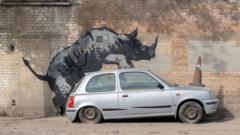
Most people see a 23-year-old car with a failed MOT as a headache that belongs in a scrapyard. To a teenager in Somerset, it was a golden ticket. This isn't your typical story about a lucky break or a massive inheritance. It's about a 17-year-old who understood the value of a "banger" in the right context. When Banksy comes to town, the rules of the car market change.
The car in question was a silver Ford Focus. It wasn't a classic. It didn't have a high-performance engine. It was, by all accounts, a bit of a wreck. But for the organizers of "Dismaland," Banksy's "bemusement park" in Weston-super-Mare, it was exactly what they needed. This shows that "value" is often just a matter of who's looking.
Why a broken Ford Focus became art
When Banksy took over the derelict Tropicana site in 2015, he wasn't looking for pristine sculptures or high-end gallery pieces. He wanted grit. He wanted a satirical take on the decay of modern life. A beat-up Ford Focus fits that narrative perfectly.
The teenager, Ben Rogers, bought the car for just £400. He knew it wouldn't pass its next inspection without costing a fortune. Instead of pouring money into a lost cause, he saw an opportunity. He'd heard the rumors about the secretive art installation and decided to take a gamble. He didn't just sell a car; he sold a prop for one of the most talked-about art events of the decade.
The reality of the Dismaland sale
Selling to a high-profile art project isn't as simple as posting an ad on Facebook Marketplace. It involves a mix of local knowledge and being in the right place at the right time. The organizers needed vehicles that looked authentic to a crumbling seaside town. Ben’s car had the right level of "wear and tear."
The transaction wasn't about the car's blue book value. It was about its aesthetic utility. Ben managed to sell the vehicle for a profit, but more importantly, he got it off his hands without paying for the scrap fees. Most car owners struggle to get rid of non-runners. Ben turned his into a piece of contemporary art history. It's a lesson in identifying niche buyers.
The logistics of selling a non-runner
If you've ever tried to sell a car that doesn't start, you know the pain. You're usually looking at:
- Paying for a tow truck.
- Negotiating with scrap dealers who want to give you pennies.
- Dealing with paperwork for a vehicle that’s basically a paperweight.
Ben skipped all of that. By selling to the show, he bypassed the traditional used car market. The production team handled the logistics because they needed that specific look for the "Dismaland" atmosphere. It highlights a massive gap in how we think about "waste." One man’s junk really is another man’s centerpiece for a social commentary on capitalism.
What this tells us about the art world
The art world is often criticized for being elitist and inaccessible. Yet, here we have a teenager from a small town making a deal with the biggest name in street art. It breaks the "ivory tower" image. Banksy’s team could have bought a car from anywhere, but they sourced locally. This grounded the project in the community it was satirizing.
It also raises questions about what we consider valuable. Is the car worth more because it was in a Banksy show? Absolutely. The provenance of being part of "Dismaland" adds a layer of history that a standard Ford Focus could never have. If that car were to be sold today, it wouldn't be priced by a mechanic. It would be priced by a collector.
How to spot your own Dismaland opportunity
You don't need Banksy to move into your backyard to find these opportunities. You just need to look at your "trash" differently. Production companies, local theaters, and even themed restaurants are constantly looking for authentic, aged items.
- Look for local production calls. Film crews often need "period-correct" or "distressed" items.
- Understand the "ugly" market. Sometimes, something being broken makes it more valuable for a specific project.
- Network with local creatives. They usually know who needs what for upcoming installations.
The legacy of the silver banger
Ben Rogers didn't just walk away with a bit of cash. He walked away with a story that most art history students would kill for. His car was seen by hundreds of thousands of people, including celebrities and global critics. It sat in the middle of a cultural phenomenon that defined 2015.
The car itself was transformed. It went from being a failed piece of transportation to a symbol of urban decay. That’s the power of context. You can take a mundane object, put it in a specific setting, and suddenly it's worth a conversation.
If you're sitting on something you think is worthless, stop and think about who might need that exact "worthless" thing. Maybe it's a broken typewriter, an old neon sign, or a car that won't start. The market for the weird and the worn-out is bigger than you think. Don't just call the scrap man yet. Search for local art groups or film scouts first. You might just have the next "banger" that belongs in a show.
Keep an eye on local permits and event listings in your town. When a major production moves in, they don't bring everything with them. They buy local, they rent local, and they look for things that feel real. Be the person who provides that reality. Get your items documented and photographed so you're ready when the next big project rolls into town. That's how you turn a £400 mistake into a legendary win.