The operational reality of civil defense in a high-intensity conflict zone is governed by urban density, historical infrastructure debt, and the physics of ballistic interception. Allegations regarding the exclusion of foreign nationals—specifically Indian workers—from Israeli bomb shelters during Iranian missile barrages fail to account for the mathematical and legal frameworks that dictate shelter accessibility. In Israel, the distribution of "safe space" is not a matter of discretionary hospitality; it is an architectural requirement codified in the 1951 Civil Defense Law.
The Tripartite Framework of Israeli Civil Defense
To analyze whether a specific demographic is being denied protection, one must first categorize the three distinct layers of the Israeli shelter system. Each layer operates under different ownership and access protocols.
1. The Merhav Mugan Dirati (MMD)
The MMD is a reinforced room within a private apartment. Under the 1992 mandate following the Gulf War, every new residential unit must include an MMD.
- Access Logic: Access is strictly limited to the residents of that specific private dwelling.
- Bottleneck: Older buildings (pre-1992) lack these rooms, creating an "infrastructure gap" that affects both citizens and foreign workers living in low-cost, older urban centers.
2. The Miklat Meshutaf
These are shared shelters located in the basements of older apartment blocks.
- Access Logic: These are communal property belonging to the building’s residents.
- Operational Reality: If an Indian worker resides in an older building with a Miklat, they have the same legal right to that space as any other tenant. However, neglect by building committees often leads to these shelters being used for storage, rendering them inaccessible to everyone, regardless of nationality.
3. The Miklat Tziburi
These are freestanding public shelters managed by local municipalities.
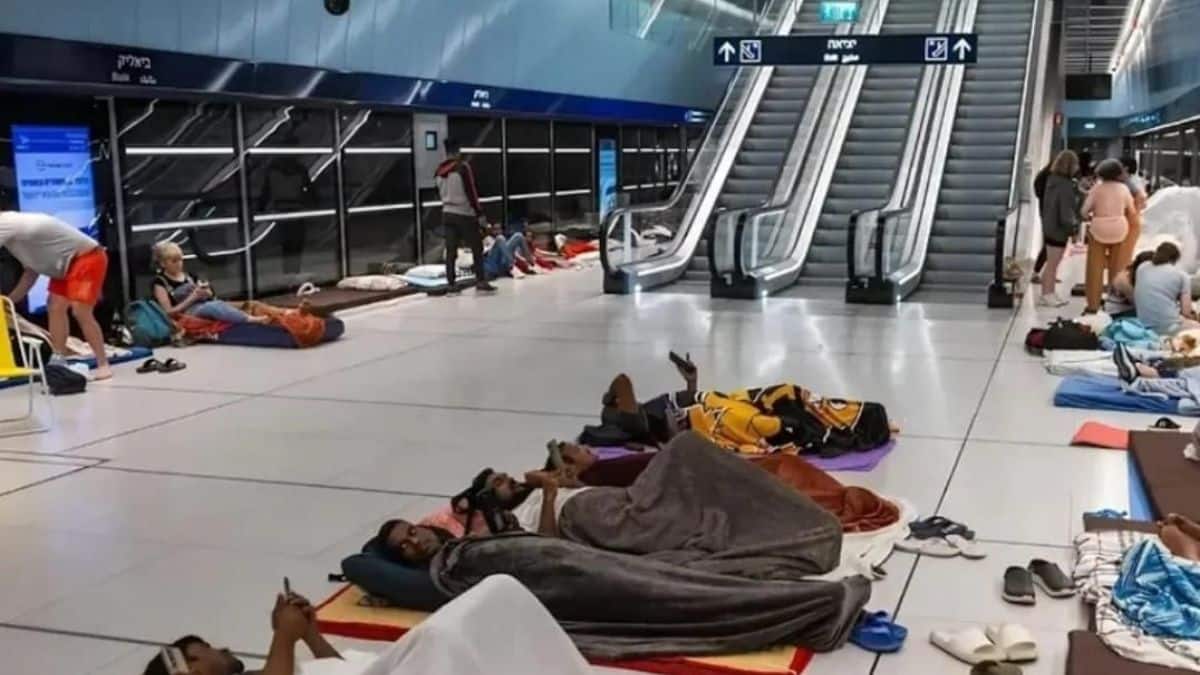
- Access Logic: Universal. By law, these must be unlocked and accessible to any individual on the street—tourist, citizen, or foreign worker—the moment an emergency is declared.
The Geography of Risk and Infrastructure Debt
The perception of "denial of access" often stems from a correlation between socioeconomic status and urban decay rather than a targeted policy of exclusion. Indian workers in Israel primarily fall into two categories: caregivers and construction/agricultural laborers.
The Caregiver Variable
Caregivers typically reside in the homes of their employers. Because they live in private residences, their access to a shelter is identical to that of the Israeli family they serve. If the family has an MMD, the caregiver is inside it. If the family lives in an old Tel Aviv walk-up without a shelter, both the employer and the caregiver are forced to rely on the "stairwell protocol"—using the building's internal core as a makeshift shield.
The Construction and Agriculture Variable
Workers in these sectors often inhabit temporary housing or older, high-density residential zones in southern Tel Aviv or peripheral industrial areas. These zones have the highest "infrastructure debt," meaning they have the lowest ratio of modern MMDs per capita. When sirens sound, the distance to the nearest Miklat Tziburi (public shelter) might exceed the "Time to Protect" (TTP) window, which ranges from 90 seconds in Tel Aviv to 15 seconds near the border.
The Mechanics of the "Open Door" Policy
The Israeli Home Front Command (HFC) operates on a doctrine of total civilian protection. This is not rooted in altruism but in the maintenance of operational continuity. Dead or injured foreign nationals create diplomatic friction and logistical burdens that the state seeks to avoid during wartime.
There is no documented directive, municipal ordinance, or military order that permits the exclusion of any individual from a public shelter based on nationality. In fact, the HFC issues instructions in multiple languages, including Hindi and Gujarati, specifically to ensure that the Indian workforce understands how to utilize the existing infrastructure.
Quantitative Constraints of the TTP (Time to Protect)
The failure to reach a shelter is frequently a function of the TTP versus the "Human Sprint Speed" (HSS).
- Detection to Siren: Radars detect the launch; the system calculates the impact zone.
- Siren to Impact: In central Israel, this is roughly 90 seconds.
- The Distance Equation: An average adult can cover approximately 200–300 meters in 90 seconds under high stress.
If an Indian worker is in a field or on a construction site where the nearest public shelter is 500 meters away, they will fail to reach it. This is a spatial limitation, not a discriminatory one. The "denial" is a byproduct of the physical environment.
The Liability Gap in Temporary Housing
A critical failure point exists in the "employer-provided housing" sector. While the state mandates shelters for permanent structures, temporary modular housing used on farms or construction sites often bypasses these rigorous codes.
- The Regulatory Loophole: Employers are legally responsible for the safety of their workers, yet enforcement in rural agricultural sectors is historically lax compared to urban residential centers.
- The Result: Workers are not "denied access" to an existing shelter; rather, the shelter was never built in their specific work-live vicinity. This is a failure of labor law enforcement and corporate compliance, distinct from a state-level policy of exclusion.
Misinterpretation of "Private Property" vs. "Public Safety"
Conflict arises when individuals attempt to enter private MMDs in buildings where they do not reside. In the chaos of a ballistic missile attack, residents may be hesitant to open their private homes to strangers. This creates anecdotal reports of being "turned away."
- Fact: No person is legally entitled to enter another person's private apartment (MMD).
- Fact: Every person is legally entitled to enter a public shelter.
Conflating these two leads to the erroneous conclusion that "Indians are being denied access to shelters." The denial is a function of private property boundaries, which apply equally to Israeli citizens who find themselves on a street where they do not live during a siren.
Strategic Recommendation for Workforce Protection
To mitigate the risk to the Indian labor force and neutralize the diplomatic volatility of these claims, a three-tier optimization of the current civil defense posture is required:
Mobile Shelter Deployment: The Israeli Ministry of Labor, in coordination with the Home Front Command, must mandate the placement of "Miguniyot" (portable reinforced concrete shelters) at every agricultural site and construction project employing more than 10 foreign nationals. This removes the TTP-HSS deficit.
Digital Literacy and Geo-Fencing: The HFC app should be pre-installed on the devices of all B-1 visa holders, with localized language support. This app provides a real-time map of the nearest public shelters, preventing workers from wasting critical seconds attempting to enter private residential blocks.
Audit of Employer-Provided Housing: A rigorous inspection surge is necessary for older apartment blocks in South Tel Aviv and industrial zones. Building committees (Va'ad Bayit) found to be using communal shelters for storage must face immediate criminal negligence charges to ensure these spaces remain viable for the migrant populations residing in those units.
The primary threat to Indian nationals in Israel is not a policy of exclusion, but the intersection of aging infrastructure and the extreme compressed timelines of modern missile warfare. Solving for the latter requires physical hardware—more shelters in more places—rather than a correction of non-existent discriminatory directives.
The strategic play is the immediate procurement and deployment of 5,000 additional Miguniyot units to industrial and agricultural zones. This is a capital expenditure that pays for itself by maintaining the stability of the labor market and preventing the catastrophic diplomatic fallout of avoidable foreign national casualties.