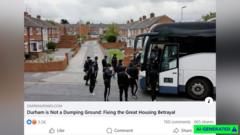
The pearl-clutching over Reform UK’s latest "AI-gate" isn’t just exhausting; it’s intellectually dishonest. When a Reform council deputy admitted to using an AI-generated image for a campaign post, the media reacted as if he’d been caught laundering money. Critics screamed about the death of truth. Fact-checkers sharpened their digital guillotines.
They’re all missing the point.
The outrage isn't about the technology. It’s about a desperate, dying grip on the idea that political imagery was ever "real" to begin with. We are witnessing the final gasps of a gatekeeper class that thinks a staged, airbrushed, professionally lit photoshoot is "authentic" while a Midjourney prompt is "deception."
The Myth of the Authentic Candidate
Let’s dismantle the biggest lie in modern politics: that there is a "real" version of the images we consume.
For decades, political campaigns have spent millions on image consultants. They use long lenses to make crowds look denser. They use color grading to make opponents look sickly and "gray." They use Photoshop to remove sweat, wrinkles, and signs of human frailty.
When a politician stands in front of a green screen or a carefully curated "working class" backdrop, that is a manufactured reality. It is a synthetic construction designed to trigger a specific emotional response.
Why is it suddenly a moral crisis when the "manufacturing" happens via an algorithm instead of a $500-an-hour consultant?
The admission of AI use shouldn’t be a scandal. It’s actually the most honest thing a politician has done in years. They are finally admitting that the image is a tool, not a mirror.
Efficiency is Not a Crime
I’ve watched campaigns burn through donor cash trying to organize "authentic" photo ops that take three days to coordinate and five minutes to execute. It’s a waste of resources.
If a councilman wants to depict a vision for a cleaner high street or a busier local market, he has two choices:
- Wait for the perfect weather, hire a photographer, find extras who look "representative," and pray the lighting holds.
- Generate the vision in sixty seconds.
The "purest" critics argue that the second option is a lie because it didn’t happen. But political campaigning has never been about what is. It has always been about what could be.
If the policy is real, the image is just a placeholder for an idea. If you’re arguing about the pixels, you’ve already lost the argument on the policy. You’re nitpicking the medium because you’re terrified of the message.
The Taxonomy of "Fake"
We need to stop grouping all AI usage into the "Deepfake" bucket. It’s a lazy linguistic trick used to shut down innovation.
- Type 1: Illustrative AI. This is what the Reform deputy did. It’s digital clip art. It’s a visual aid. No one actually believes the councilman is standing in a hyper-saturated, perfectly symmetrical version of reality.
- Type 2: Malicious Deception. This is putting words in a rival’s mouth. This is the fake audio of a prime minister or a staged video of a riot that never happened.
The media intentionally blurs the line between these two because it creates a better headline. By treating a campaign poster like a high-level disinformation campaign, they are crying wolf. When the actual malicious deepfakes arrive—the ones that start wars or crash markets—the public will be too desensitized to care.
The High Cost of "Truth"
The irony is that the loudest voices against AI in politics are usually the ones with the biggest budgets.
Established parties love the "AI is dangerous" narrative because it protects their moat. High-end production is expensive. If you can make a professional-grade campaign ad for the price of a monthly subscription, the barrier to entry for smaller, disruptive parties vanishes.
This isn't a fight for "truth." It’s a fight for the status quo.
When you demand that every image be "real," you are demanding that every candidate have the bankroll to afford a traditional media team. You are gatekeeping democracy via the cost of a camera lens.
Why the Public Doesn’t Care
Here is the truth that the pundits won't tell you: The average voter doesn't give a damn if the sun in your campaign photo was generated by a GPU or a lucky break in the clouds.
They care if their bins are collected. They care if their energy bills are skyrocketing. They care if the person asking for their vote is competent.
Focusing on the "deception" of an AI image is a distraction for the elite. It’s a way for people who spend all day on social media to feel superior to the "unwashed masses" who might be fooled.
The "masses" aren't fooled. They know it's an ad. They treat it with the same skepticism they apply to a burger in a McDonald's commercial versus the one they get in the box. They understand the difference between marketing and reality.
The Transparency Trap
The solution being pushed by the "experts" is mandatory labeling. "This image was generated by AI."
Fine. Let’s do it. But let's be consistent.
- "This image was color-corrected to make the candidate look less pale."
- "This crowd was shot with a 200mm lens to hide the empty seats at the back."
- "This quote was edited for clarity and to remove the candidate's stutter."
If we are going to demand a "Warning: Synthetic" tag on AI, we must demand it on every piece of political theater. If you only target the algorithm, you’re not defending the truth; you’re defending a specific, legacy style of lying.
Stop Treating Voters Like Idiots
The underlying current of this entire controversy is a profound condescension toward the electorate. The "AI is a threat to democracy" crowd believes that the public is a mindless sponge, incapable of discerning intent or checking facts.
In reality, the proliferation of AI will make the public more skeptical, not less. We are entering an era of radical skepticism where nothing is believed at face value. That is a healthy development for a democracy.
The Reform deputy didn't undermine trust in politics. Politics undermined trust in politics decades ago. AI is just the latest tool being used in a game that has been rigged since the invention of the printing press.
Stop pretending a JPEG is the problem. The problem is a political class that would rather argue about a computer-generated sky than the crumbling ground beneath their feet.
Delete the apology. Hire a better prompt engineer. The future of the "image" is already here, and it doesn't care about your feelings on authenticity.
Build the vision. Let the critics keep their "reality." It’s clearly not working for them.