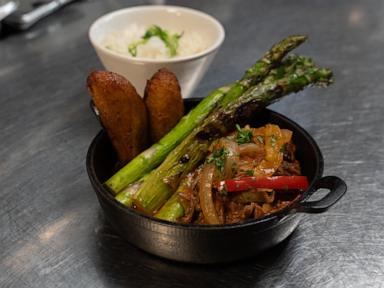
You’ve seen it. You order a $22 pasta dish and it arrives in a bowl the size of a hubcap. Halfway through, you’re hitting a wall. By the time the check comes, you’re asking for a plastic container that’ll sit in your fridge until it becomes a science project. It’s a waste. It’s expensive for the restaurant, and honestly, it’s making us all feel a bit sluggish.
The era of "supersized" everything is dying a quiet, necessary death. Restaurants are finally waking up to the fact that customers don’t actually want a mountain of fries if it means the bill keeps climbing. Smaller portions are becoming the defining restaurant trend of 2026. This isn't just about "light bites" or being stingy. It’s a calculated response to a world where we’re all watching our bank accounts and our waistlines with equal intensity.
The Shrinking Plate Meets the Expanding Bill
Inflation didn't just hit the grocery store. It slammed the kitchen door of every bistro and diner in the country. When the cost of beef, eggs, and vegetable oil spiked, chefs had two choices. They could raise prices until nobody could afford to walk through the door, or they could get smarter about what actually goes on the plate.
Most people don't realize that massive portions are an efficiency nightmare. High food waste is a silent killer for profit margins. According to data from ReFED, a non-profit focused on food waste, the restaurant industry loses billions every year on food that never gets eaten. By trimming the portion size, a restaurant can keep their entry price point lower. You get to eat out for $18 instead of $26. The restaurant keeps its margin. Everybody wins.
It’s a psychological shift. We used to equate "value" with "volume." If the plate was overflowing, we felt like we got a deal. Now, value means quality. I’d rather have four ounces of a perfectly seared, grass-fed hanger steak than twelve ounces of a chewy, mediocre cut that leaves me needing a nap.
The GLP-1 Effect is Reshaping the Menu
We can't talk about smaller portions without talking about the elephant in the room. Or rather, the thinning elephant. The massive surge in GLP-1 medications like Ozempic and Wegovy is fundamentally changing how millions of people interact with food.
These drugs don't just help people lose weight. They change the brain's reward system and significantly slow down gastric emptying. People on these medications literally cannot finish a traditional American restaurant portion. If a restaurant only offers "Mega-Sized" meals, they’re effectively alienating a huge—and growing—demographic of diners.
Smart operators are introducing "half-portions" or "right-sized" entrees. These aren't just for kids anymore. They’re for the professional who wants the flavor of a signature dish without the physical discomfort of overeating. National chains and local spots alike are seeing that offering flexibility keeps these customers coming back. If I know I can go to a place and get a portion that won't make me feel sick, I’m going there twice a month instead of once a year.
Why the Side Dish is the New Main Event
The traditional "Protein + Starch + Veg" layout is getting a makeover. We’re seeing a rise in "modular" dining. Instead of one giant plate, menus are shifting toward high-quality small plates and "enhanced" sides.
Think about it. You go out with three friends. Instead of everyone ordering a $35 entree and sitting in silence as you struggle through them, you order six or seven smaller dishes. You try the charred octopus, the truffle polenta, and the roasted marrow bones. It’s more social. It’s more interesting. It’s also a goldmine for the restaurant.
From a business perspective, small plates (or tapas-style dining) often lead to a higher "per-capita" spend. You think, "Oh, it’s only $12," and then you order four of them. You end up spending more than you would on a single entree, but you feel better about it because you had a diverse culinary experience.
Sustainability Isn't Just a Buzzword
Smaller portions have a massive environmental impact. Less food on the plate means less food in the trash. Less food in the trash means less methane in landfills. It’s a direct line.
Chefs are also using smaller portions to showcase luxury ingredients that would be priced out of a standard entree. You can’t put a 10-ounce portion of wild-caught Chilean sea bass on a mid-range menu. The price would be astronomical. But a 5-ounce portion? Suddenly, it’s accessible. It allows for more sustainable sourcing because the restaurant isn't buying in massive, wasteful bulk.
How to Navigate the New Menu Landscape
If you're a diner, stop looking for the biggest plate. Look for the most intense flavors. If you're a restaurant owner, stop fearing the "small portion" label. Own it. Call it "Focused Dining" or "Curation."
Here is how you actually win in this new environment:
- Ask for half-portions. Even if it’s not on the menu, many kitchens will accommodate you and charge a fair price.
- Order from the "Starters" only. Two appetizers and a side of greens is often the perfect meal.
- Focus on density. High-protein, high-flavor foods satisfy the brain much faster than empty carbs used as plate-fillers.
- Prioritize the experience. Dining out should be about the atmosphere and the company, not just the caloric intake.
The trend toward smaller portions isn't a sign of a struggling economy. It’s a sign of a maturing one. We're moving away from mindless consumption and toward intentional eating. It’s better for your wallet. It’s better for your health. And it’s definitely better for the planet.
Next time you see a "petit" option on the menu, don't feel cheated. View it as a chance to actually enjoy your food instead of just finishing it. Start by auditing your next meal out—pay attention to how much you actually eat versus how much you leave behind. That gap is where the future of the industry lives.