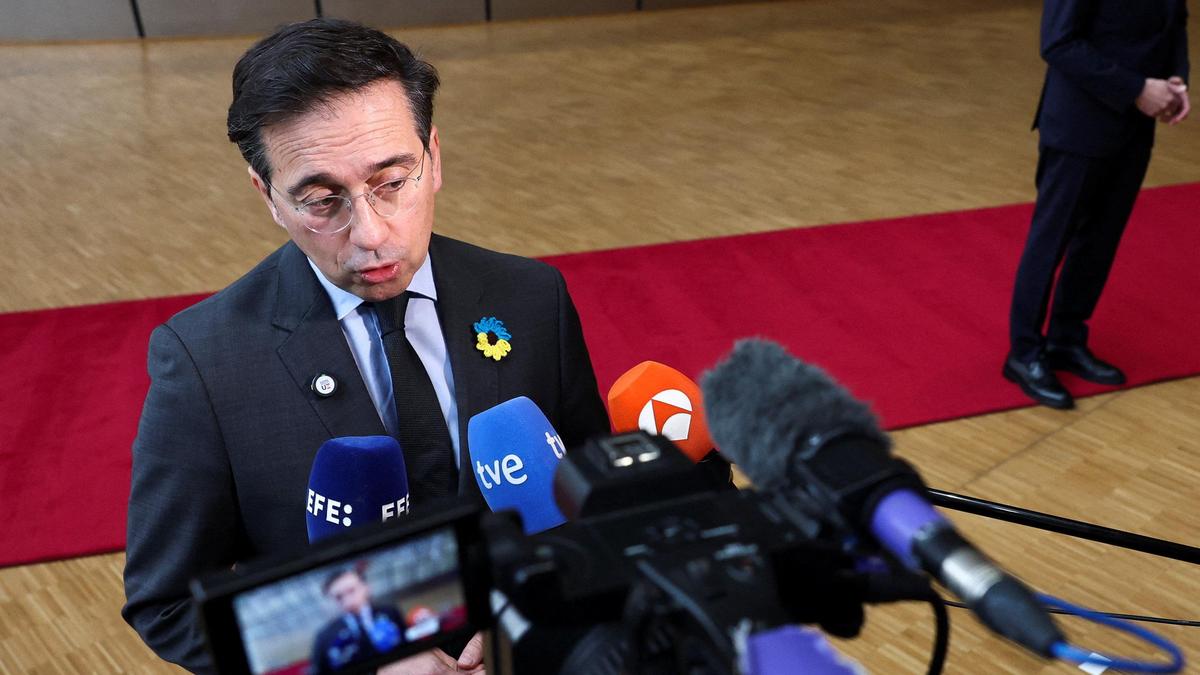
Spain is currently the only major NATO ally standing in direct, public opposition to the joint U.S.-Israeli military campaign against Iran. While the White House claims Madrid has finally "agreed to cooperate," Spanish Foreign Minister José Manuel Albares has spent the last forty-eight hours flatly calling those claims a fabrication. This is not just a disagreement over flight paths or refueling rights; it is a fundamental fracture in the Atlantic alliance that has left the strategic bases at Rota and Morón de la Frontera effectively neutralized for the duration of the conflict.
The tension reached a boiling point when President Donald Trump threatened to sever all trade ties with Spain, a move that would bypass standard European Union trade protocols and likely trigger a constitutional crisis in Washington. Spain’s Prime Minister Pedro Sánchez remains unmoved. He has framed his refusal to allow U.S. aircraft to use Spanish soil for strikes as a defense of the UN Charter, but the reality is more complex. It is a calculated move to position Spain as the moral arbiter of Europe, even as it risks a catastrophic economic embargo from its most powerful ally.
Sovereignty under the Southern Sun
For decades, the naval base at Rota and the air base at Morón have served as the "gas station of the Mediterranean." They are essential for any sustained American military operation in the Middle East. Under the bilateral Agreement on Defense Cooperation, the U.S. maintains a significant presence there, but the "joint use" clause is the friction point. Spain maintains ultimate command.
When the Pentagon attempted to launch KC-135 tanker aircraft from Morón to support strike packages over Iran this week, Madrid pulled the plug. The Spanish Ministry of Defense argued that the strikes do not fall under the "proportionate defensive action" clauses of the treaty. Defense Minister Margarita Robles was blunt, stating that the bases will not be used for anything outside the UN Charter.
The U.S. response was swift. At least fifteen aircraft, including the vital tankers, were forced to scramble and relocate to Ramstein Air Base in Germany. This detour is not just a logistical headache; it adds hours to flight times and increases the strain on a refueling fleet already stretched thin. By forcing American assets out, Sánchez has effectively increased the operational cost and risk for every sortie flown against Tehran.
The Trade Embargo Gambit
In the Oval Office, the reaction has shifted from frustration to outright hostility. President Trump’s directive to Treasury Secretary Scott Bessent to "cut off all dealings with Spain" marks a departure from traditional diplomacy. The U.S. administration argues that by denying base access, Spain is "putting American lives at risk" by slowing down the prosecution of the war.
The legal mechanism for such a trade halt is shaky at best. The U.S. Supreme Court recently limited the president’s ability to impose sweeping global tariffs under emergency powers. However, the administration is now pivoting toward a "full-scale embargo" model, similar to the restrictions placed on sanctioned adversaries.
Spain is not an easy target for this kind of economic warfare. As a member of the EU, any trade action against Spain is technically an action against the entire bloc. Yet, the Spanish business chambers, including CEOE and CEPYME, are visibly shaken. They represent a trade relationship worth billions, yet the government in Madrid insists it has the "resources to contain the impact" of a severed relationship. This is a bold claim for a country still balancing a delicate post-pandemic recovery and high energy costs.
Why Sánchez Won't Back Down
To understand the Spanish defiance, one must look at the domestic political landscape. Sánchez is often described as Europe’s last major progressive leader, and his "No to War" stance resonates deeply with a Spanish electorate that remembers the fallout of the 2003 Iraq intervention. For Sánchez, standing up to Washington is a potent political tool. It consolidates his left-wing base and paints him as a leader who prioritizes international law over geopolitical bullying.
There is also a significant divergence in how Madrid views the threat from Iran compared to its neighbors. While France and the UK have moved toward supporting "proportionate" strikes after their own assets in the region were targeted, Spain remains focused on de-escalation. Madrid’s priority is the safety of the 30,000 Spanish citizens in the Middle East and its 1,000 troops currently deployed in UN and NATO missions in Lebanon, Iraq, and Turkey.
The Spanish government views the current U.S.-Israeli strategy as a "logic of violence" that leads only to a spiral of retaliation. They are betting that the conflict will eventually require a mediator who hasn't picked a side. By staying out of the cockpit, Spain hopes to be that mediator.
The Cost of the Rift
The immediate result of this standoff is a deeply compromised southern flank for NATO. While the U.S. has two destroyers, the USS Roosevelt and the USS Bulkeley, stationed at Rota, their role is currently limited to missile defense for Israel. They are not being utilized for offensive strikes from Spanish waters because doing so would trigger a complete eviction of U.S. forces from the base.
The U.S. military is currently "coordinating with their counterparts," as the White House claims, but this coordination is likely limited to administrative and defensive logistics, not the offensive cooperation Washington desires. The rift is deepening, not closing.
Spain’s refusal is a gamble that international law will eventually provide a shield against American economic reprisal. If the U.S. follows through on the threat to end trade, the "special relationship" between Madrid and Washington will be dead for a generation. For now, the tankers are in Germany, the ports in Spain are quiet, and the White House is waiting for a crack in the Spanish resolve that hasn't appeared.
Monitor the upcoming NATO ministerial meeting for signs of whether other Mediterranean allies, like Italy or Greece, follow Spain's lead or move to fill the strategic void left by the closure of Rota and Morón.