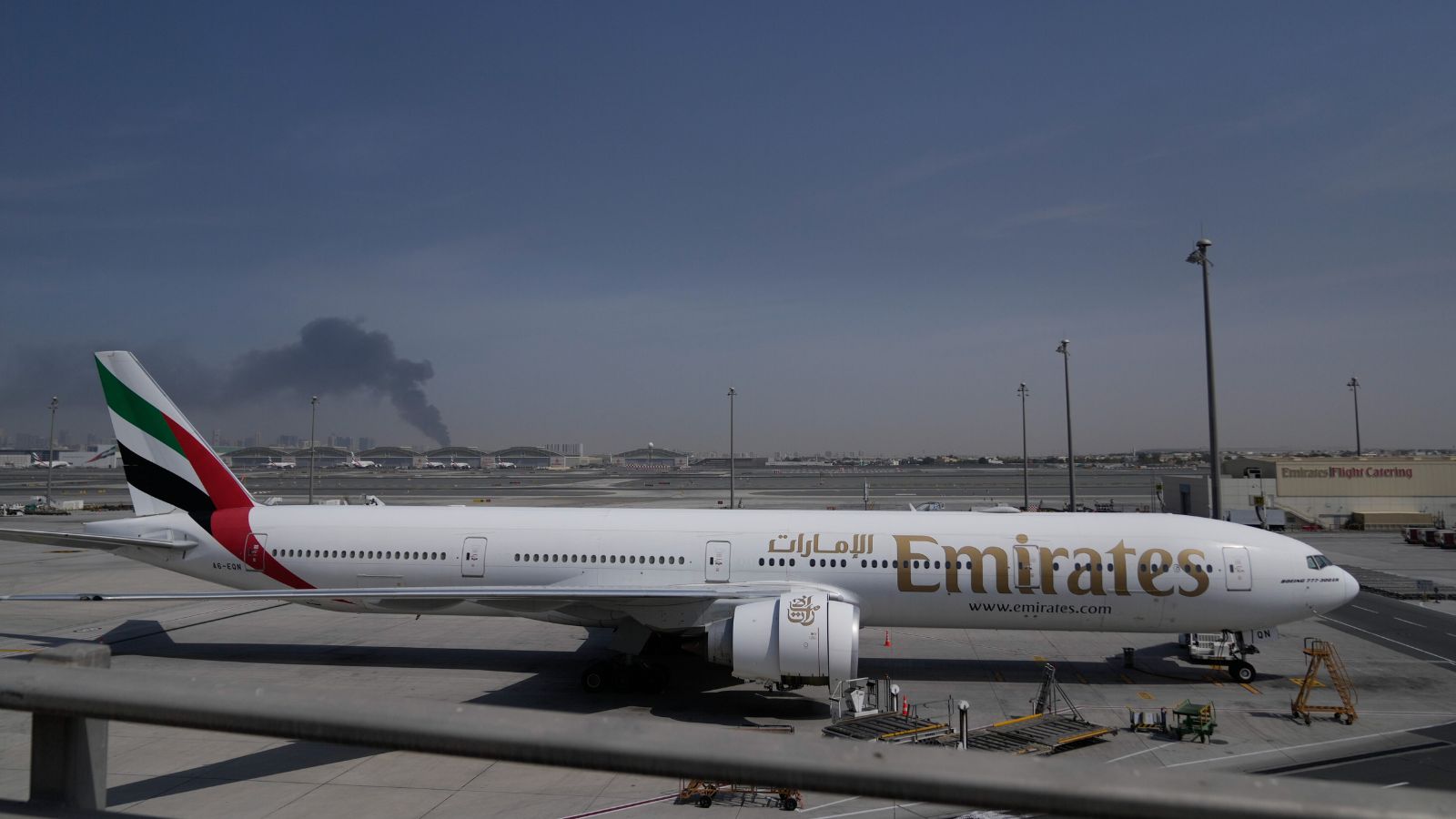
The suspension of flight operations at Dubai International Airport (DXB) following a "debris incident" during a period of heightened Iran-US military friction is not a localized logistics failure; it is a case study in the extreme sensitivity of high-utilization aviation nodes to geopolitical kinetic events. When a primary global hub—responsible for processing over 80 million passengers annually—ceases movement, the cause-and-effect chain radiates through three distinct layers: technical safety thresholds, insurance risk re-rating, and the structural redirection of international capital flows.
Understanding this disruption requires moving past the surface-level reporting of "delays" and examining the specific mechanics of why a debris sighting triggers a total system freeze in a conflict zone.
The Triad of Operational Suspension
Airport operators do not halt traffic based on vague fears; they respond to objective breaches of safety and liability protocols. In the context of the reported Iran-US tensions, the presence of unidentified debris on a runway or within the immediate terminal maneuvering area (TMA) activates a three-part failure sequence.
Foreign Object Debris (FOD) Risk and Turbine Physics: At the velocity required for a Boeing 777 or Airbus A380 takeoff, a piece of metallic debris weighing less than 500 grams can cause catastrophic uncontained engine failure. In a theater of active military engagement, "debris" is a euphemism for potential ordnance fragments or reconnaissance drone components. The kinetic energy $E_k$ of a small object struck at takeoff speeds (approximately 150 knots) is calculated by:
$$E_k = \frac{1}{2}mv^2$$
This energy is sufficient to breach engine cowlings, leading to immediate fire or loss of thrust during the most critical phase of flight.The Sovereignty of NOTAMs and Liability: Air traffic control (ATC) issues Notices to Air Missions (NOTAMs) to legally insulate the airport authority. Once a debris threat is identified, the airport’s liability insurance becomes void for any pilot who attempts to operate without a "clear" status. In the Middle East, where war risk insurance premiums are already volatile, a 30-minute suspension is a calculated financial hedge against a billion-dollar hull loss.
The Saturation Point of the TMA: Dubai operates on a "hub-and-spoke" model with minimal temporal slack. Unlike decentralized networks, DXB relies on precise arrival waves. A 60-minute closure does not result in a 60-minute delay; it creates a compounding "holding stack" problem. Aircraft fuel reserves are calculated with limited loitering time (typically 30–45 minutes of contingency). When the stack exceeds this limit, mass diversions to Al Maktoum (DWC) or Sharjah (SHJ) occur, breaking the crew-rest cycles and airframe rotations for the next 48 hours.
Geopolitical Friction as a Supply Chain Bottleneck
The proximity of Dubai to the Strait of Hormuz places its flight paths within the "High Threat Environment" designated by various civil aviation authorities (like the FAA or EASA) during Iran-US escalations. The strategic logic of the suspension involves more than just physical debris; it involves the electronic and psychological environment of the airspace.
The Signal Interference Factor
Military activity in the Gulf frequently involves Electronic Countermeasures (ECM) and GPS jamming. If the "debris" mentioned in reports was an intercepted drone or a missile fragment, the primary concern for DXB is the integrity of the Global Navigation Satellite System (SS) signals.
- Spoofing: Forcing aircraft to deviate from their programmed glide slope.
- Jamming: Total loss of GPS-based navigation, forcing a reliance on older, less precise Inertial Reference Systems (IRS) or ground-based VOR/DME.
In a high-density environment like Dubai, the loss of GPS precision reduces the "separation minima" (the required distance between planes), effectively cutting the airport's capacity by 50% or more even if the runways are technically open.
The Insurance Risk Multiplier
Aviation insurers utilize "Hull War, Hijacking and Other Perils" clauses. During a period of active Iran-US warfare, these premiums are not static. A debris incident at a major hub serves as a "trigger event" that allows underwriters to invoke 7-day notice periods to cancel or re-rate policies. For Emirates and FlyDubai, a persistent debris threat translates to a direct increase in Operating Cost Per Available Seat Kilometer (CASK).
Measuring the Economic Shockwave
The suspension of Dubai's operations creates a localized "bullwhip effect" in global logistics. Because DXB acts as the bridge between the European and Asia-Pacific markets, the halt of operations is felt in the belly-hold cargo capacity of the world.
- Time-Sensitive Shipments: High-value electronics and perishables moving from Southeast Asia to the EU are delayed.
- The Transit-Passenger Chokepoint: Approximately 70% of DXB traffic is transit-based. A suspension strands thousands of passengers who have no legal entry visa for the UAE, forcing the airport into a humanitarian and security management role for which it is not primarily designed.
- Fuel Burn Inefficiency: Diverted flights and extended holding patterns increase the carbon footprint and fuel expenditure of the global fleet. A single diverted A380 can cost an airline upwards of $150,000 in fuel, landing fees, and passenger compensation.
Structural Vulnerabilities of the Single-Hub Strategy
The Dubai incident exposes the risk inherent in the "Mega-Hub" strategy favored by Gulf nations. While centralization creates massive economies of scale and allows for the existence of airlines like Emirates, it creates a single point of failure.
- Geographic Concentration: All of Dubai’s aviation assets are within a 30-mile radius. Kinetic debris from an offshore interception (US Navy vs. Iranian assets) can effectively close the entire national economy’s primary engine.
- The Interdependence of Civil and Military Airspace: The UAE’s airspace is tightly constrained. When military tension rises, "Available Airspace" shrinks as military zones expand. This leaves civil aviation thin corridors to navigate. A debris incident in one of these narrow corridors is far more disruptive than it would be in the expansive airspace of the United States or Australia.
Strategic Mitigation for Global Operators
For stakeholders monitoring this escalation, the "debris incident" is a leading indicator of a deteriorating safety environment. The following frameworks should guide future risk assessment:
The Proactive Diversion Protocol
Airlines must now factor "Geopolitical Slack" into their fuel loading for Gulf transits. This means carrying an additional 20–30 minutes of "discretionary fuel" beyond the legal requirement to avoid the necessity of diverting to secondary airports during brief suspensions.
Diversification of Regional Routing
Logistics firms should analyze the viability of the "Southern Route" via African hubs (Addis Ababa or Johannesburg) or the "Polar Route" as redundancies. While these routes increase flight time, they bypass the Hormuz chokepoint entirely, decoupling the supply chain from the Iran-US conflict cycle.
Real-Time Kinetic Intelligence
Investment in private-sector intelligence that monitors missile telemetry and drone activity in the Persian Gulf is no longer optional for major carriers. Relying solely on government-issued NOTAMs creates a lag in response time. Operators who move to "Ground Stop" status 15 minutes before a debris event is officially confirmed save millions in airborne fuel burn.
The suspension at Dubai International is a warning of the "New Normal" in aviation: where the barrier between geopolitical kinetic energy and commercial operation is increasingly porous. The ability to distinguish between a temporary mechanical delay and a systemic geopolitical threat will determine the survivability of regional carriers in the coming decade.
Strategic Recommendation: Shift the primary risk assessment focus from "Aircraft Safety" to "Network Integrity." The threat is no longer the loss of a single airframe to debris, but the loss of the hub's viability for 24-hour cycles. Move to a dual-hub operations model, splitting critical transit waves between DXB and DWC to ensure that a localized debris field cannot paralyze the entire national aviation infrastructure.