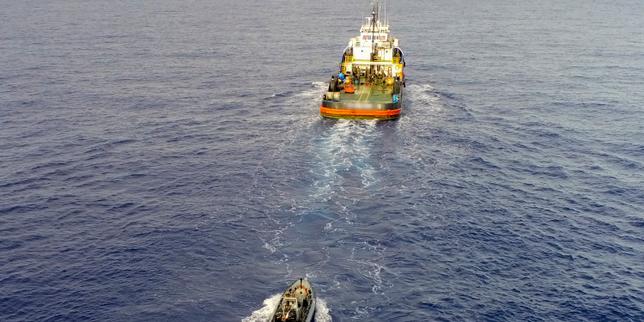
The Pacific Islands are no longer just the backdrop for luxury postcards and honeymoon retreats. They have become the most critical logistics hub for global drug cartels moving multi-ton shipments of cocaine and methamphetamine from the Americas and Asia toward the hyper-profitable markets of Australia and New Zealand. This is not a sudden accident of geography. It is the result of a calculated shift by organized crime syndicates that have identified a massive security vacuum in the middle of the ocean.
While the world focuses on the traditional border crossings of North America and Europe, the South Pacific has been transformed into a "toll road" for the Sinaloa Cartel, the Jalisco New Generation Cartel (CJNG), and Chinese triads. These groups utilize the vast, unmonitored maritime spaces of Fiji, Tonga, and New Caledonia to "wash" their cargo, transferring it from massive mother ships to smaller local vessels that can slip into Australian ports undetected.
The islands are paying for this transit in a currency they cannot afford. Because the cartels often pay local facilitators in product rather than cash, islands with zero history of hard drug use are now facing domestic addiction epidemics that their fragile healthcare systems are entirely unprepared to handle.
The Infrastructure of a Transoceanic Pipeline
The logistics of moving drugs across the Pacific rely on the "Ant Trail" strategy. In the past, smugglers might try to run a single large vessel directly into a major port. Modern surveillance has made that a suicide mission. Instead, the South Pacific serves as a staging ground. Large fishing trawlers or commercial vessels depart from Ecuador or Colombia, carrying several tons of cocaine. They meet smaller yachts or pleasure craft in the middle of the "Blue Border"—the millions of square kilometers of open water surrounding tiny island nations.
These remote atolls provide the perfect cover for ship-to-ship transfers. Once the cargo is broken down into smaller packages, it is distributed among a fleet of sailboats and catamarans. These vessels, often registered to Western "grey nomads" or shell companies, blend in perfectly with the thousands of recreational boats cruising the Pacific.
Fiji has emerged as the unwilling capital of this trade. Its position as a regional transport hub makes it an ideal transshipment point. The sheer volume of legitimate maritime traffic allows illicit cargo to hide in plain sight. When a shipment is "lost" or seized, the ripple effects are felt instantly in the local economy. But the real danger lies in the spillover effect.
The Barter System of Addiction
One of the most devastating aspects of this trade is how the labor is compensated. Cartels are pragmatic. Moving physical cash across borders is risky and leaves a paper trail. Instead, local islanders who assist with refueling, storage, or offloading are often paid in the very product they are moving.
This has introduced high-purity methamphetamine and cocaine into communities that previously only dealt with alcohol or kava. In places like Tonga, the social fabric is tearing at the seams. We are seeing a rise in "ice" addiction among populations that have no access to rehabilitation clinics or specialized psychiatric care. The cost of a "hit" in Nuku'alofa is now lower than the price of a decent meal, a direct result of the oversupply caused by these transit operations.
Why the Current Security Model is Failing
The international community, led by Australia and the United States, has responded with increased naval patrols and "shiprider" agreements, where local officers ride on foreign navy vessels. While these efforts lead to the occasional record-breaking seizure, they fail to address the fundamental structural weakness: the lack of basic maritime domain awareness.
Most Pacific Island nations possess only a handful of patrol boats to monitor Exclusive Economic Zones (EEZs) that are hundreds of times larger than their landmass. To put this in perspective, imagine a single police car trying to patrol the entire state of Texas, but the car can only travel at twenty miles per hour and the criminals have stealth jets.
The Corruption of Sovereignty
Money talks louder than law enforcement in regions where the GDP is dwarfed by the street value of a single cocaine shipment. A 500-kilogram haul of cocaine has a wholesale value in Sydney of roughly $60 million. That single shipment is worth more than the annual budget of several Pacific government departments.
This creates an environment where institutional capture is inevitable. It is not just about bribing a customs officer at a dock. It is about the subtle infiltration of the political class. We see this through suspicious "investment" projects, the sudden appearance of luxury vehicles in impoverished villages, and the granting of fishing licenses to front companies that never actually bring any fish to market.
The cartels are not just moving drugs; they are buying influence. By the time an international agency realizes a particular port is compromised, the syndicates have already integrated themselves into the local power structure.
The Australia-New Zealand Gravity Well
The primary driver of this crisis is the staggering price of drugs in the Tasman Sea. Because of their isolation and strict border controls, Australia and New Zealand are the most expensive drug markets in the world. A gram of cocaine that costs $5 in Colombia and $150 in Los Angeles can fetch $400 in Melbourne.
This massive profit margin allows cartels to absorb significant losses. If the Australian Federal Police (AFP) seizes two tons of cocaine, the cartel simply writes it off as the cost of doing business and sends four tons next time. The "risk-to-reward" ratio is so heavily skewed in favor of the criminals that traditional interdiction is effectively useless as a deterrent.
The Role of Outlaw Motorcycle Gangs
The logistics on the "receiving" end are handled by a sophisticated network of Outlaw Motorcycle Gangs (OMCGs) and Middle Eastern crime syndicates based in Australia. These groups have established permanent bases in Southeast Asia and the Pacific to coordinate directly with the cartels.
They are the "last mile" delivery service. By using the Pacific Islands as a buffer zone, they move the point of highest risk away from the Australian mainland. If a boat is intercepted in the waters off Vanuatu, the Australian bosses remain untouched. They simply find a new skipper and a new route.
The Invisible Cost to Tourism and Development
There is a secondary, quieter crisis unfolding in the tourism sector. Many of these islands rely almost entirely on their reputation as safe, pristine paradises. As organized crime takes root, the collateral damage includes a rise in violent crime, theft, and domestic instability.
Investors are starting to take notice. When a country's judicial system is perceived as being under the thumb of drug lords, legitimate foreign direct investment dries up. This forces the islands into a vicious cycle: as the legal economy weakens, the illicit economy becomes the only viable source of income for the youth.
- Social Erosion: Traditional communal structures are failing as elders lose control over a younger generation fueled by easy drug money.
- Health Crisis: A lack of testing facilities means that "tainted" batches of drugs are killing users who have no idea what they are consuming.
- Legal Paralysis: Overburdened courts are backlogged for years with drug-related cases, allowing high-level traffickers to remain on the street while they wait for trials that may never happen.
A New Strategy for the Blue Continent
If the goal is to actually disrupt these networks, the focus must shift from "seizures at sea" to "resilience on land." This means moving beyond the occasional donation of a patrol boat and toward the long-term strengthening of local institutions.
The only way to break the cartel's grip is to make the Pacific Islands an inhospitable environment for them to operate. This requires:
- Financial Intelligence Units: Small island nations need the technical capability to track suspicious money flows. You don't stop a cartel by catching a boat; you stop it by freezing the bank accounts of the people who paid for the boat.
- Regional Intelligence Sharing: The cartels exploit the fact that Pacific nations often don't talk to each other. A suspicious vessel that is kicked out of Samoan waters simply sails to Fiji. A unified, real-time tracking database is mandatory.
- Demand Reduction in Australia: As long as the demand in Sydney and Auckland remains insatiable, the Pacific will remain a target. The burden of this crisis lies with the consumers in wealthy nations, not just the transit points.
The South Pacific is currently the weakest link in the global security chain. Until the international community treats these island nations as strategic partners rather than just scenic stopovers, the blue water of the Pacific will continue to turn white with the weight of the world's drug trade.
The cartels have already built their infrastructure. They have their captains, their warehouses, and their political allies. The question is whether the rest of the world is willing to spend even a fraction of what they spend on the "War on Drugs" to bolster the sovereignty of the islands that are currently being swallowed by it.