The air in the room feels different when the rhetoric shifts from policy to personhood. It gets thinner. It gets colder. When Donald Trump stood before the microphones to label the leaders of Iran "deranged scumbags," he wasn't just recycling his greatest hits of playground insults. He was pulling a specific lever in the machinery of global tension. It is a lever that bypasses the brain and goes straight to the gut, where the primitive fears live.
Words matter. They are the scaffolding upon which we build peace, or the fuel we pour onto the sparks of a regional brushfire.
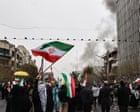
To understand the weight of these two words, we have to look past the velvet ropes of a campaign rally and toward the dusty, vibrating borders of the Levant. Imagine a shopkeeper in Tehran named Elias. He is a hypothetical man, but his anxiety is a statistical certainty shared by millions. Elias doesn't care about the nuances of nuclear enrichment or the intricacies of the JCPOA. He cares about the price of flour and whether his son will be drafted into a war sparked by a sentence uttered six thousand miles away. When he hears a former and potential future American president use the vocabulary of a bar fight to describe his government, Elias doesn't see a political strategy. He sees a target painted on his roof.
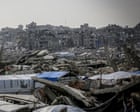
The Middle East is currently a room filled with gas. The violence in Gaza, the drone strikes in the Red Sea, and the shadow boxing between Israel and Hezbollah have created a saturation of volatility. In this environment, diplomacy usually requires the precision of a surgeon. Trump, however, prefers the impact of a sledgehammer.
The Anatomy of an Insult
Calling a geopolitical adversary a "deranged scumbag" is a calculated act of dehumanization. It is a rhetorical technique designed to signal to a domestic audience that the "other" is not just wrong, but fundamentally broken. This isn't the language of negotiation. You do not negotiate with a "scumbag." You remove them. You neutralize them.
The strategy serves a dual purpose. First, it satisfies a base desire for strength. In a world that feels chaotic and unpredictable, hearing a leader use blunt, aggressive language provides a temporary illusion of control. It feels like someone is finally telling it like it is. But the cost of that dopamine hit is paid in the currency of stability.
Consider the mechanics of escalation. In international relations, there is a concept known as the "Security Dilemma." It suggests that when one side takes an action to increase its own security—or in this case, uses aggressive language to project strength—the other side perceives it as a direct threat. They respond in kind. The spiral tightens.
Donald Trump’s rhetoric operates on a feedback loop. He characterizes the Iranian regime as erratic and dangerous—a claim supported by the regime's own history of regional interference and human rights abuses—but he does so using language that mirrors the very erraticism he decries. It is a hall of mirrors where the only exit is a door marked "conflict."
The Invisible Stakes
While the headlines focus on the name-calling, the reality on the ground is far more visceral. Behind the "scumbag" label are the actual mechanics of war. We are talking about the $USS$ Gerald R. Ford carrier strike group. We are talking about the Shahed drones buzzing over the desert. We are talking about the silent, invisible code of cyber warfare that could shut down a power grid or a hospital in an instant.
The danger of this specific brand of rhetoric is that it leaves no room for the "off-ramp." If you spent four years convincing your population that the people on the other side of the table are sub-human or mentally unstable, you cannot easily sit down with them to sign a treaty. You have burned the table.
We have seen this play out before. History is littered with the corpses of people who lived in the gap between a leader's ego and a neighbor's pride. In the 1914 lead-up to the Great War, the personal insults traded between European monarchs—who were literally cousins—helped grease the wheels of a mobilization that no one seemed able to stop. Today, the speed of communication has increased, but the fragility of the human ego remains unchanged.
The Ghost of 2020
To grasp why this latest outburst feels so heavy, we have to remember the smoke rising from the Baghdad airport in January 2020. The assassination of Qasem Soleimani was the ultimate physical manifestation of the "scumbag" rhetoric. It was a moment where the words became lead.
For the Iranian leadership, Trump is not just a politician; he is the man who ordered the death of their most celebrated general. When he calls them "deranged," he is reminding them that he is willing to act outside the traditional norms of international engagement. This creates a terrifying kind of unpredictability.
In a standard geopolitical landscape, actors are expected to be rational. They are expected to weigh costs and benefits. But when the language becomes personal, the logic of the state is replaced by the logic of the feud. A feud doesn't care about GDP. A feud doesn't care about the long-term stability of the Strait of Hormuz. A feud only cares about who gets the last word.
The Human Cost of High-Stakes Theater
We often treat these political rallies as a form of entertainment. We analyze the "optics" and the "polling data." We wonder if the "base" is energized. But there is a disconnect between the spectacle in a climate-controlled arena and the consequence in a cold trench.
Imagine a young soldier stationed in the Golan Heights. Let's call him David. He is twenty years old. He has a girlfriend who sends him voice notes about the new coffee shop in Tel Aviv. When David reads the news on his phone during a break, he sees the "deranged scumbag" headline. He knows that every time a Western leader cranks up the heat, his own life becomes a little more precarious. He is the one who will have to look through a thermal scope at three in the morning. He is the one who will have to deal with the fallout of a "tough" speech.
The tragedy of modern populism is that it treats the world like a movie where the hero can say the perfect one-liner and then the credits roll. But in reality, there are no credits. There is only the next day. And the day after that.
The Middle East is currently enduring one of its most painful chapters in decades. The death tolls are not just numbers; they are empty chairs at dinner tables in Gaza, in Kibbutzim, in Beirut, and in Tehran. Using this moment to test out new insults is like lighting a cigarette while standing in a pool of gasoline. It’s not just reckless. It’s a betrayal of the gravity of the situation.
The Weight of the Silence
What happens when the shouting stops? Eventually, the microphones are turned off, the crowds go home, and the leaders retreat to their fortified estates. But the words remain. They settle into the soil. They are translated into Farsi and broadcast on state-run television to justify further crackdowns on dissent. They are used by extremists to recruit the next generation of martyrs.
Trump’s supporters argue that this is how you handle bullies. They say that the "polite" language of the past got us nowhere, and that the only thing a regime like Iran understands is strength. There is a seductive logic to this. It feels honest. It feels brave.
But there is a profound difference between strength and bellicosity. True strength is the ability to hold a position of power without losing one's grip on the consequences of its use. It is the ability to be firm without being frantic.
The "deranged scumbag" comment isn't a sign of a master strategist at work. It is the sound of a man who knows how to start a fire but has no interest in how to put it out. It is the sound of a world that has forgotten how to speak the language of de-escalation.
As the violence in the Middle East continues to spiral, we are left to wonder if we are witnessing the final breakdown of the old order. The institutions that were built to prevent a global conflagration are fraying. The diplomatic channels are clogged with vitriol.
We are living in an era where the most powerful people on earth communicate through the lens of a grievance-fueled megaphone. It is loud. It is angry. And it is incredibly fragile.
Elias, the shopkeeper in Tehran, closes his shutters for the night. He hears the wind whipping through the narrow streets. He wonders if the tomorrow he has planned—the inventory he needs to order, the daughter he needs to walk to school—will actually happen. He is waiting for a sign that the people in charge understand the value of his quiet, ordinary life.
Instead, he gets a headline.
The abyss doesn't just stare back. It listens. And right now, it is hearing exactly what it needs to justify its next move.
The true cost of a word is never paid by the person who says it. It is paid by the people who have to live in its shadow. We are all living in that shadow now, waiting to see if the next word uttered will be the one that finally sets the world on fire.