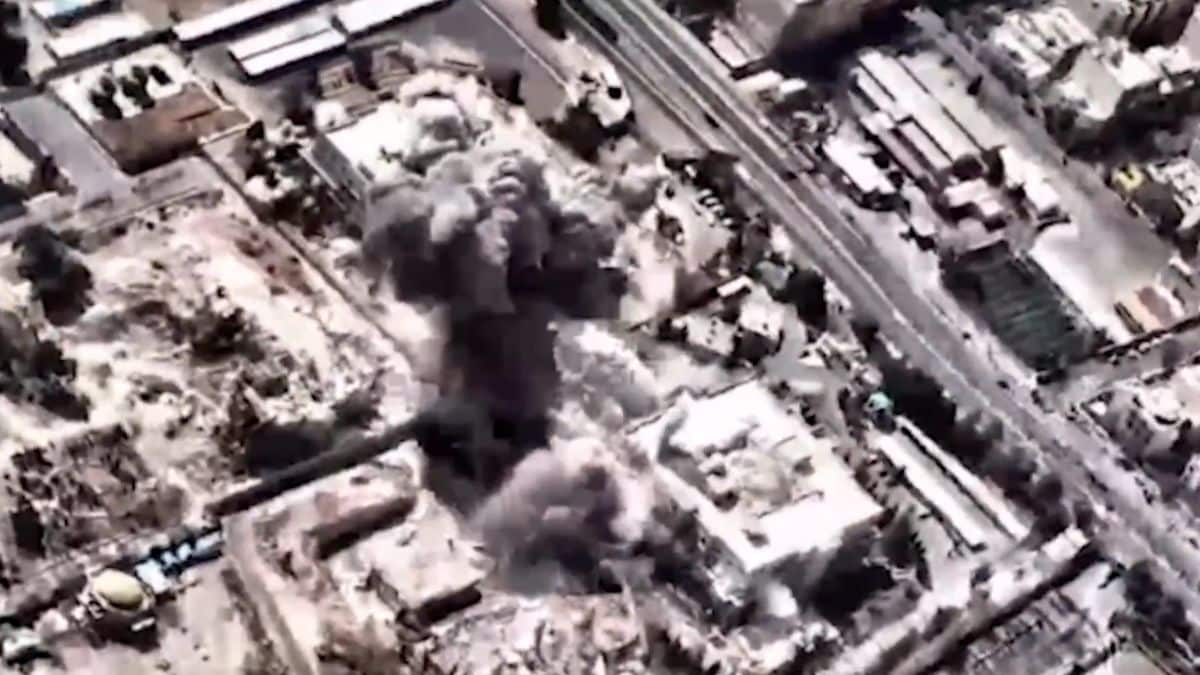
Modern theater dominance is no longer defined by the volume of fire but by the compression of the sensor-to-shooter timeline. When US forces intercepted an Iranian-backed militia attempting to launch a cruise missile or long-range rocket, the event was not merely a mechanical destruction of hardware; it was the successful execution of a high-stakes kinetic race. To understand the operational reality of these strikes, one must analyze the interplay between persistent overhead surveillance, electronic signature detection, and the physics of terminal guidance.
The Architecture of the Preemptive Kill Chain
A preemptive strike is defined by its timing relative to the enemy’s launch sequence. In the context of irregular warfare in the Middle East, the US military employs a "Find, Fix, Track, Target, Engage, and Assess" (F2T2EA) framework. The effectiveness of this framework relies on breaking the adversary's "OODA" loop—Observe, Orient, Decide, Act—before they can achieve the "Act" phase.
The sequence begins with Persistent Surveillance. Low Earth Orbit (LEO) satellites and Unmanned Aerial Systems (UAS) like the MQ-9 Reaper provide continuous "staring" capability over known launch corridors. These assets do not just look for vehicles; they monitor specific behavioral anomalies:
- Infrastructure Preparation: The removal of camouflage netting or the positioning of support vehicles.
- Thermal Signatures: The heat bloom of a liquid-fuel engine warming up or the electrical discharge of a mobile launcher's hydraulic leveling system.
- Electronic Emissions: The activation of fire-control radars or encrypted radio bursts used for final coordinates.
Once the target is fixed, the "Target" and "Engage" phases must occur within a window often measured in seconds. If the missile leaves the rail, the mission shifts from a "strike" to "active defense" (interception), which is exponentially more expensive and carries a higher risk of failure.
The Physics of Precision Neutralization
The choice of ordnance in these strikes is governed by the need to minimize collateral damage while ensuring the total destruction of the propellant and warhead. A missile on a launcher is a highly volatile chemical system.
The Propellant Volatility Factor
Most tactical missiles used by proxy forces in the region utilize solid or storable liquid propellants. These substances act as force multipliers for the attacking US platform. By hitting the missile while it is fueled and upright, the US ordnance—typically an AGM-114 Hellfire or a GBU-39 Small Diameter Bomb—triggers a secondary explosion. This "sympathetic detonation" ensures the platform is unrecoverable without requiring a high-yield warhead that might level nearby civilian structures.
Kinetic Energy vs. Chemical Energy
In specific urban or high-risk environments, the US has utilized the R9X "Flying Ginseng" variant of the Hellfire. This weapon replaces an explosive warhead with deployable blades. The logic here is purely mechanical: use the kinetic energy of a 100-pound projectile traveling at Mach 1.3 to shred the missile’s guidance system and airframe. This renders the missile inert without igniting the fuel, a critical choice if the launch site is positioned near non-combatant infrastructure—a common tactic in "human shield" operational logic.
The Logistics of the Mobile Launch Platform
The primary challenge in these engagements is the "Scud-hunt" problem—the inherent mobility of the adversary. Unlike silo-based ICBMs, the tactical missiles used by Iranian-backed groups are mounted on Transporter Erector Launchers (TELs).
The TEL operates under a specific Cost-Risk Function:
- The Concealment Benefit: The ability to hide in garages, tunnels, or orchards until the moment of firing.
- The Launch Cost: The 10-20 minute window when the TEL is stationary, leveling its chassis, and erecting the missile. This is the moment of peak vulnerability.
- The Flee Success Probability: The speed at which the TEL can lower the launcher and move after fire.
The US air strike described in the original article represents a failure of the "Concealment Benefit" and the "Flee Success Probability." The strike occurred during the "Launch Cost" window. When a TEL is struck mid-erection, the hydraulic systems fail, and the missile often pins the vehicle to the ground. This results in the complete loss of a high-value asset—the launcher—which is often harder for proxy groups to replace than the missile itself.
The Signal and the Noise: Electronic Intelligence (ELINT)
Beyond the visual, the strike against Iranian-backed groups often involves the "Silent Battle." Before a missile can be fired, its guidance system needs a GPS lock or a link to a ground control station.
Electronic Intelligence (ELINT) aircraft, such as the RC-135 Rivet Joint, monitor these signals. A "squawk" from a missile's radio altimeter or a burst from its command link serves as a digital flare. This signal is immediately geolocated and handed off to the nearest tactical air asset. This process is the Integrated Fire Control (IFC) loop. The speed of the strike indicates that the "sensor-to-shooter" path was likely automated, with AI-driven algorithms flagging the signal for human verification in near real-time.
The Strategy of Deterrence through Transparency
The release of strike footage is not a PR exercise; it is a tactical communication. In modern conflict, "information operations" are inseparable from kinetic ones. By releasing high-resolution imagery of a missile being destroyed mid-preparation, the US military sends a specific signal to the adversary's command structure:
- Proof of Infiltration: Our sensors have bypassed your camouflage and operational security (OPSEC).
- Negation of Investment: Your multi-million dollar missile program is being neutralized by a relatively inexpensive 50-pound warhead.
- Psychological Friction: The next launch crew will be acutely aware that they are being watched from an altitude they cannot see or hear.
Tactical Conclusion and Forward Posture
The ability of US forces to consistently neutralize missile units before they fire indicates a mature "Kill Web" in the region. This is not a static defense but an active, preemptive posture. The next phase of this evolution will see the integration of hypersonic interceptors and directed-energy weapons (lasers), further compressing the engagement timeline.
For the adversary, the tactical counter is limited. They must either increase the speed of their launch sequence—reducing the "Launch Cost" window—or saturate US sensors with a high volume of decoy TELs. However, as long as US ELINT and thermal imaging maintain their current resolution, the "Concealment Benefit" of mobile launchers will continue to erode.
Strategic Recommendation: Focus on the Attrition of Launchers. While missiles are consumable, the Transporter Erector Launchers (TELs) are the strategic bottleneck. Every preemptive strike that destroys a TEL disrupts the adversary's capability for weeks, not just minutes. Future operations should prioritize the total destruction of these platforms over the neutralization of the individual missile to ensure long-term regional stability through logistical exhaustion.
Would you like me to analyze the specific electronic warfare counter-measures used by TEL units to avoid detection?