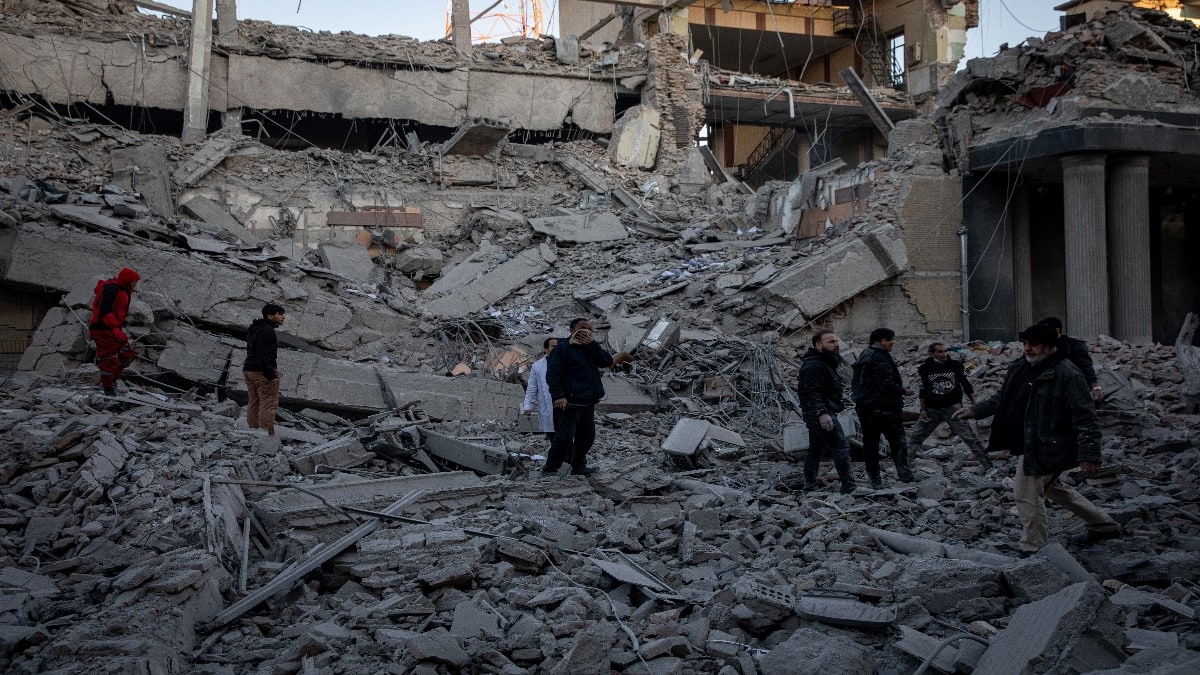
Israel just dropped 5,000 bombs on Iran in less than a week. Think about that number for a second. It's not just a statistic; it's a statement of absolute aerial dominance that we haven't seen in this region—maybe ever. The Israel Defense Forces (IDF) recently went public with footage of these strikes, specifically targeting Tehran, and the visuals are exactly as grim as you'd imagine.
If you're trying to figure out if this is just another "tit-for-tat" exchange, stop. It's not. We've moved past the era of symbolic strikes and "calibrated" responses. By releasing high-definition video of explosions in the heart of the Iranian capital, Israel isn't just hitting targets; it's dismantling the psychological shield the Islamic Republic has spent decades building.
The sheer scale of the 5000 bomb barrage
Most people don't realize how fast this escalated. In the "Twelve-Day War" back in June 2025, Israel used about 4,000 munitions over nearly two weeks. This time? They hit the 4,000 mark in just four days. By the fifth day, the tally crossed 5,000. That’s a sustained pace of 1,000 bombs every 24 hours.
You can’t drop that much hardware without a massive list of "quality" targets. This wasn't carpet bombing in the traditional, messy sense. It was a surgical, high-volume demolition of Iran's military backbone. The IDF confirmed they've been hitting:
- Ballistic missile arrays: Over 300 launchers are reportedly neutralized.
- Command centers: The IRGC headquarters, the Basij paramilitary hubs, and the Quds Force offices in Tehran took direct hits.
- Nuclear infrastructure: Facilities in Isfahan, specifically those linked to Ghadr missile production and storage, were leveled.
The strategy here is obvious. Israel is trying to "empty the clip" of the Iranian regime before they can mount a coordinated response. When you destroy the launchers on the ground while they're being fueled—which the IDF claims to have done multiple times this week—you aren't just defending; you're castrating the enemy's long-range capabilities.
Why the Tehran footage matters more than the bombs
Military analysts often talk about "kinetic effects," but the real war is fought in the minds of the people living under the bombs. By releasing footage of the Tehran strikes, Israel is sending a blunt message to the Iranian leadership: "We see you, we can reach you, and your air defenses are useless."
The videos show massive fireballs lighting up the Tehran skyline. We're seeing precision strikes on the Intelligence Directorate and the Internal Security forces. For years, the regime told its people that Tehran was a fortress. That lie died this week. The footage proves that the "ring of fire" Iran tried to build around Israel has been bypassed. Instead, the fire is now concentrated in the streets of the capital.
The myth of the Iranian air defense
For a long time, there was a lot of talk about how sophisticated Iran's Russian-made S-300 systems and their homegrown Bavar-373 batteries were. This week’s campaign basically turned those systems into expensive scrap metal.
The first wave of the current offensive didn't even go for the missiles. It went for the eyes—the radars. Once the radar net was shredded, the Israeli Air Force (IAF) had "freedom of action." That’s military speak for "we can fly wherever we want." 1,600 sorties later, and the results are visible from space.
It’s a massive failure of deterrence for Tehran. If you can't protect your own Intelligence Directorate or the IRGC headquarters in your own capital, you’ve lost the mandate of strength.
What happens when the smoke clears
People keep asking: "Is this the end of the regime?" It's too early for that, but the foundations are definitely cracked. Reports are swirling about the fate of the Supreme Leader, with Benjamin Netanyahu hinting that Khamenei might not even be alive. Whether that’s psychological warfare or a hard fact remains to be seen, but the silence from the top in Tehran is deafening.
Iran is struggling. Their missile launch rate has dropped from over 100 a day to about 20. They're running out of functioning launchers, and their command structure is in shambles. But don't mistake a wounded regime for a dead one. They still have proxies, and they still have deep-buried assets.
The next few days are going to be about whether Israel decides to finish the job on the remaining nuclear sites or if the international community forces a pause. Honestly, with 5,000 bombs already dropped, a "pause" feels like a pipe dream.
Keep an eye on the Western Iranian border. The IDF just announced they're shifting focus from Tehran to Western Iran to mop up what’s left of the mobile missile units. This isn't slowing down. It's widening.
If you want to stay ahead of the curve on this, stop looking at the official state media from either side. Watch the satellite imagery. Watch the localized Telegram channels coming out of Tehran and Isfahan. That's where the real story of the damage is being told, far away from the sanitized press releases.