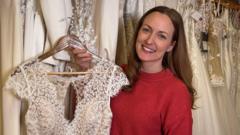
The zipper stuck halfway up Sarah’s spine. It wasn’t a matter of fit; she was as lithe as she’d been in college. It was the age of the teeth. This particular silk slip dress had already danced through a reception in 1996, sat in a cedar chest for two decades, and was now being asked to perform one more miracle in a dimly lit boutique in East London.
Sarah looked at herself in the mirror. The silk was heavy, a creamy liquid gold that they simply don’t make anymore—not for less than the cost of a mid-sized sedan, anyway. She felt a strange, electric connection to a woman she’d never met. This wasn't just a garment. It was a baton being passed.
We are conditioned to believe that a wedding dress must be "virginal" in its history, not just its color. The industry feeds us a specific brand of magic: the idea that for a marriage to be pristine, the outfit must be untouched by another’s memories. But as the price of a single day’s joy climbs toward the $40,000 mark for the average American wedding, that magic is starting to feel like a very expensive sleight of hand.
The Weight of a Single Day
Every year, millions of white dresses are manufactured, shipped across oceans, worn for exactly eight hours, and then entombed in plastic. It is a linear journey to a dead end.
Consider the math of a traditional "new" gown. To produce one polyester wedding dress, you’re looking at hundreds of hours of labor and a carbon footprint that rivals a cross-country road trip. Then there is the water. To grow the cotton or process the synthetics for a standard bridal look, thousands of gallons are diverted from ecosystems.
When you buy second-hand, those environmental costs are essentially erased. You are not "consuming"; you are "curating."
But the resistance to pre-loved gowns isn't usually about the planet or the pocketbook. It’s about the "ick" factor—a superstitious whisper that someone else’s "bad vibes" or a failed marriage might cling to the lace like a scent.
This is a ghost we’ve created to keep the registers ringing.
The Myth of the Tabula Rasa
The "New is Better" narrative relies on the idea of the Tabula Rasa, or the blank slate. We want our weddings to be the beginning of time. However, anyone who has actually lived through a decade of partnership knows that the best parts of life are built on layers.
I spoke with a vintage dealer who specializes in gowns from the 1920s through the 1970s. She told me about a bride who bought a 1950s Dior-style swing dress. The original owner had been married in it for fifty years before passing away.
"The bride didn't see it as someone else's old clothes," the dealer said. "She saw it as a garment that already knew how to stay married."
That is a powerful shift in perspective. Instead of fearing the history of a dress, we can lean into its resilience. A second-hand dress is a proven survivor. It has survived the champagne spills, the frantic dancing, and the passage of time. It is, in many ways, a more honest symbol for a marriage than something that has never been tested.
The Economics of the Secret Market
Let’s talk about the cold, hard numbers that the bridal magazines usually bury in the back.
A brand-new designer gown from a high-end boutique often carries a 300% to 500% markup. The moment you walk out the door with it, the value drops by half. It is the worst investment you will ever make.
By contrast, the second-hand market—sites like Stillwhite, NearylyNewlywed, or local consignment shops—allows brides to access labels like Vera Wang, Monique Lhuillier, or Oscar de la Renta for 40% to 70% off the retail price.
- Retail: $6,000
- Second-hand: $2,200
- The Difference: A down payment on a house, a three-week honeymoon in Japan, or the ability to actually afford the open bar you promised your friends.
The logic is undeniable, yet the emotional barrier remains. We are told we are "worth" the new dress. But is our worth tied to being the first person to touch a piece of fabric, or is it tied to the wisdom of starting a shared life without a mountain of unnecessary debt?
The Hunt and the High
Shopping for a new dress is a choreographed performance. You make an appointment. You drink lukewarm prosecco. You stand on a pedestal while a consultant tells you that "you're having a moment."
It’s lovely. It’s also a script.
Shopping for a second-hand dress is an adventure. It requires a different kind of eye. You have to look past a slightly dusty hem or a missing bead and see the architecture of the piece. You are a scout. An editor.
There is a specific rush that comes with finding a gem in the rough. When Sarah finally zipped that 1996 silk slip dress all the way up, she didn't feel like a customer. She felt like a winner. She had bypassed the assembly line. She had found something with soul, something that couldn't be found in a catalog on page 42.
The Invisible Stakes of "Something Old"
We often forget the tradition of "Something Old, Something New, Something Borrowed, Something Blue."
In our modern rush to buy everything "new," we’ve neglected the "old" and the "borrowed." Historically, these weren't just rhymes; they were ways to connect the bride to her community and her ancestry. Wearing a pre-owned dress is perhaps the ultimate homage to this tradition.
It is a rejection of the "disposable" culture that has infected every corner of our lives. We live in an era of fast fashion where clothes are designed to fall apart after five washes. A wedding dress, however, is one of the last bastions of real craftsmanship. These garments are often built with internal corsetry, hand-sewn lace, and French seams—details that are meant to last a century, not a season.
To let such a work of art sit in a box forever is a tragedy. To wear it again is an act of restoration.
The Tailor is Your Best Friend
One of the greatest myths of second-hand shopping is that the dress won't fit.
"But I’m a size 6 and the dress is a size 10," people say.
Here is a secret: Almost every wedding dress, new or old, requires professional tailoring. A dress from a boutique is rarely a perfect fit off the rack. When you buy second-hand, you take the thousands of dollars you saved and you give a fraction of it to a master tailor.
They can drop a neckline. They can add sleeves. They can remove three layers of heavy tulle to turn a "Cinderella" ballgown into a sleek, modern column.
This is where the dress becomes yours. It’s not just "used." It’s "reborn." You are participating in the design process, ensuring that the final product is a reflection of your specific body and your specific style, rather than a mass-produced silhouette.
The Ethics of the Glow
There is a quiet, smug satisfaction that comes with a second-hand wedding.
When people compliment your dress—and they will, because vintage or high-end second-hand silk has a luster that cheap modern synthetics can't mimic—you get to tell them the truth. You get to tell them it’s a recycled masterpiece.
You aren't just a bride; you’re a rebel.
You’ve looked at a multi-billion dollar industry designed to make you feel inadequate if you don't spend a fortune, and you’ve said "no." You’ve chosen the story over the status symbol.
The Final Fitting
Sarah wore the gold silk dress.
She walked down a grassy aisle in a backyard in Vermont. The hem got a little bit stained by the clover. She spilled a drop of red wine on the bodice during a toast. And you know what? It didn't matter.
The dress had already been through a wedding. It knew the drill. It didn't demand that she sit perfectly still or worry about the resale value. It was there to serve her, not the other way around.
When the night ended, she didn't feel the need to hermetically seal it in a box for the next thirty years. She gave it to a younger cousin who had always admired her style.
The dress is now waiting for its third wedding. It’s getting a little frayed at the edges, and the zipper is still a bit temperamental. But it carries the laughter of two different families in its threads. It’s becoming a legend.
We spend so much time worrying about the "firsts"—the first kiss, the first dance, the first look. But there is a profound beauty in being the second, the third, or the fourth. It means the thing you are holding has value that lasts longer than a single afternoon. It means the love it represents isn't a fragile, new thing, but something durable, tested, and infinitely renewable.
Next time you see a white dress in a window, don't ask if it’s new. Ask if it’s ready to live again.