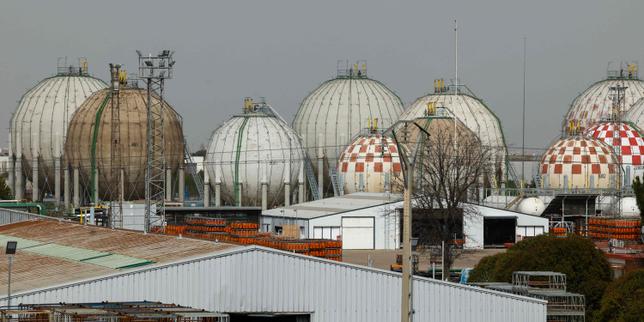
The headlines are screaming about a "shoc énergétique" like it’s a terminal diagnosis. They want you to believe that rising gas prices are a monster under the bed, waiting to devour European industry and freeze the middle class. They are wrong. This isn't a crisis; it’s a long-overdue market correction that is finally forcing Europe to grow up.
For decades, the continent operated on a delusional hit of cheap Siberian gas. It was a geopolitical payday loan with predatory interest rates. Now that the bill has come due, the punditry class is panicking because they can’t imagine a world where energy isn't subsidized by strategic vulnerability.
If you want to understand why the "shock" is actually a filter, look at the data. High prices are the only mechanism powerful enough to kill the zombie industries that have been dragging down European productivity since 2008.
The Myth of the Energy Victim
The current narrative treats Europe as a passive victim of market forces. This is a lie. Europe is an architect of its own volatility. By refusing to commit to long-term LNG contracts and obsessing over spot-market prices when they were low, European buyers left themselves exposed.
When prices spike, the "lazy consensus" screams for price caps. Price caps are the financial equivalent of putting a Band-Aid on a compound fracture. They mask the signal. High prices are a signal. They tell you that your current model is inefficient. If your business only survives when gas is $20/MWh, you don’t have a business; you have a hobby funded by the taxpayer.
I’ve sat in rooms with manufacturing CEOs who spent years ignoring efficiency audits because gas was "too cheap to worry about." Those same executives are now the ones crying to Brussels for bailouts. We should let them fail. The capital and labor trapped in those inefficient firms need to be liquidated and reallocated to sectors that can actually compete in a high-cost environment.
The Efficiency Paradox
There is a concept in economics called Jevons Paradox. It suggests that as technological progress increases the efficiency with which a resource is used, the total consumption of that resource actually rises because of increasing demand.
$$E = \frac{W}{Q}$$
In this formula, where $E$ is efficiency, $W$ is useful work, and $Q$ is energy input, Europe has been stagnant. We haven't been doing more work; we’ve just been enjoying the luxury of cheap $Q$.
The "shock" forces a reversal. When $Q$ becomes expensive, the only way to maintain $W$ is to radically re-engineer $E$. We are seeing this now in the German Mittelstand. Companies that ignored heat pumps and industrial electrification for a decade managed to cut gas consumption by 15-20% in a single year without losing equivalent output. They weren't "saving" energy before; they were wasting it because it was socially acceptable to be lazy.
Why "Energy Sovereignty" is a Buzzword for Protectionism
Politicians love the phrase "energy sovereignty." It sounds noble. In practice, it usually means burning billions on inefficient local projects that can't compete with global markets.
The reality is that Europe will never be energy independent in the way the United States is. The geology isn't there. The North Sea is a declining asset. Fracking in France is a political non-starter. Trying to build a fortress Europe around energy is a fool’s errand.
True resilience doesn't come from producing every therm of gas locally. It comes from optionality.
- Optionality is having the infrastructure to switch between Qatari LNG, American exports, and Norwegian pipeline gas in 48 hours.
- Optionality is a grid that can handle 80% intermittency because it’s backed by massive, decentralized storage, not just "hope."
The "shock" is finally forcing the build-out of LNG terminals that should have been built in 2014. It is forcing the interconnection of the Iberian Peninsula with the rest of the continent. The high price is the only thing that made these projects bankable. Without the "crisis," we’d still be talking about these projects in white papers in 2035.
The Brutal Truth About Deindustrialization
You will hear that high gas prices are "deindustrializing" Europe.
Good.
We need to deindustrialize the parts of the economy that are stuck in 1974. If Europe wants to lead, it cannot be as a low-cost bulk chemical producer or a primary steel smelter using primitive furnaces. China and India will always win that race.
Europe’s future is in high-margin, low-energy-intensity precision engineering and green tech. High energy prices act as a Darwinian pressure. They kill off the bottom-feeders and force the survivors to move up the value chain.
Consider the "green hydrogen" hype. At low gas prices, green hydrogen is a fairy tale. At high gas prices, the $4-6/kg price point for hydrogen produced via electrolysis starts to look like a bargain. The "shock" is the greatest accelerator of the energy transition we have ever seen. It did more for decarbonization in eighteen months than ten years of COP summits.
The Storage Trap
People ask: "What happens when the tanks are full?"
They think full storage means the crisis is over. This is a fundamental misunderstanding of how the grid works. Storage is a buffer, not a source.
Imagine a scenario where Europe enters a winter with 95% storage levels but faces a three-week "Dunkelflaute"—a period with no wind and no sun. If gas prices are artificially suppressed by government intervention, demand remains high. The storage drains. By February, the continent is dark.
High prices perform "demand destruction." It’s a cold term, but a necessary one. It forces the thermostat down. It forces the factory to shift its shift-patterns to off-peak hours. It keeps the lights on by making it too expensive to leave them on for no reason.
Stop Asking the Wrong Questions
Most analysts are asking: "When will gas prices return to normal?"
The answer is: Never. And you should be glad.
"Normal" was a geopolitical trap. "Normal" was an environmental disaster. "Normal" was a subsidy for corporate stagnation.
The question you should be asking is: "How quickly can we rebuild our economy to thrive at $50/MWh?"
Those who are waiting for a return to the status quo are already dead; they just haven't stopped breathing yet. The winners of the next decade are the ones who stopped complaining about the price of gas and started treating energy as a precious, high-cost input that requires surgical precision to use.
If you are waiting for the government to "fix" the energy market so you can go back to your 2019 business model, you are the problem. The shock isn't a threat to Europe; it's the only thing that can save it from its own obsolescence.
The era of cheap, easy energy was a fluke of history. It’s over. Burn the maps of the old world. They won't help you navigate this one.