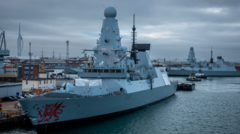
The sea does not care about geopolitics. To a sailor standing on the deck of a Type 45 destroyer, the Mediterranean is a vast, shimmering indifference that can turn violent in a heartbeat. But the steel beneath their boots is different. The HMS Dragon is not merely a collection of rivets, turbines, and Sea Viper missiles. It is a 7,500-tonne statement of intent, painted with a distinctive red Welsh dragon on its bow, now cutting through the swells toward Cyprus.
Steel. Salt. Silence. Recently making news in this space: The Kinetic Deficit Dynamics of Pakistan Afghanistan Cross Border Conflict.
When the news broke that the Royal Navy was deploying this specific vessel to the Eastern Mediterranean, the headlines focused on "regional stability" and "contingency planning." Those are sterile words. They hide the reality of what it means to put a high-tech sentry at a crossroads of global tension. Cyprus sits as a stationary aircraft carrier in a neighborhood that has become increasingly unpredictable. By sending the Dragon, the UK is not just moving a pawn; it is placing a shield over a vital nerve center.
Consider a young logistics officer at RAF Akrotiri in Cyprus. Let’s call her Sarah. For weeks, Sarah has watched the horizon. Her job involves ensuring that aid reaches Gaza and that British nationals have a clear path home if the fires in the region spread. To Sarah, the arrival of a Type 45 destroyer isn’t about a press release. It is about the "air picture"—the invisible web of radar and data that tells her the skies are safe. More insights regarding the matter are covered by Reuters.
The HMS Dragon is essentially a floating supercomputer. Its Sampson radar can track an object the size of a cricket ball traveling at three times the speed of sound from over 400 kilometers away. In the cluttered, crowded airspace of the Levant, where drones, fighter jets, and commercial airliners weave a dangerous braid, that level of clarity is the difference between a successful mission and a catastrophe.
The Eastern Mediterranean has become a crowded theater. To understand why this deployment matters, look at the map of the Leviathan gas fields and the shipping lanes that feed the Suez Canal. It is a bottleneck of human ambition and ancient grievances. When the British government moves a ship like the Dragon, they are responding to a specific kind of modern anxiety: the fear of the "blind spot."
Modern warfare and modern humanitarian efforts both rely on the same thing—information. Without it, you are throwing darts in a dark room. The Dragon illuminates that room. Its presence near Cyprus provides a protective umbrella that extends for hundreds of miles. This isn’t just about the potential to intercept missiles; it is about the psychological comfort of knowing exactly what is moving in the air and on the water.
But there is a human cost to this high-stakes chess. Behind every technical specification of the Type 45’s propulsion system are 190 men and women who just left Portsmouth. They are missing birthdays, anniversaries, and the quiet rhythm of life on land. They live in a world of grey paint and fluorescent lights, governed by watches and drills. Their reality is a constant state of readiness for a conflict everyone hopes will never come.
The ship itself is a marvel of British engineering, but it is also a temperamental beast. The Type 45 class has faced well-documented struggles with its cooling systems in warmer waters. The "Intercooler" issues of years past are a reminder that even the most sophisticated technology is vulnerable to the environment. However, the Dragon arrives now with upgraded resilience. It has been hardened. It is designed to breathe the hot, humid air of the Med without faltering.
Why Cyprus? Why now?
The island is more than a holiday destination or a relic of colonial history. It is the West's most forward-leaning ear and eye in the Middle East. With the Sovereign Base Areas of Akrotiri and Dhekelia, the UK maintains a footprint that allows for rapid humanitarian response. If a full-scale evacuation of civilians from Lebanon or surrounding areas becomes necessary, Cyprus is the life raft. The HMS Dragon is the lifeguard.
History suggests that the mere presence of such a vessel changes the math for everyone else in the region. It is a concept called "fleet in being." You don't necessarily have to fire a shot to be effective. You just have to be there, visible on the radar of every actor in the area, signaling that the cost of miscalculation has just gone up.
The red dragon on the hull is a piece of psychological theater. It is a bit of flair in a world of drab military utility. To the crew, it’s a source of pride. To an adversary, it’s a signature. It says that this is not an anonymous patrol boat. This is one of the most capable air-defense destroyers on the planet.
We often talk about these deployments as if they are abstract movements of budget and hardware. We forget the smell of diesel and the vibration of the deck plates. We forget that when the Dragon docks in Limassol, it brings with it the weight of a nation’s foreign policy and the hopes of thousands of people who just want the world to remain steady for one more day.
The stakes are invisible until they aren't. They are the missed signals, the misinterpreted drone flights, and the accidental incursions that lead to escalation. By filling the gap in the air picture, the Dragon tries to ensure those mistakes don't happen. It is a guardian of the status quo in a place where the status quo is under constant assault.
As the sun sets over the Mediterranean, casting a long, golden shadow behind the destroyer’s mast, the mission remains the same. The crew continues their drills. The radar continues its silent, 360-degree sweep. The dragon on the bow stares forward, its red eyes fixed on a horizon that holds both the promise of peace and the threat of a storm.
The ship is now at the threshold. What happens next depends on whether the world chooses to see the shield, or the sword.
The ocean remains indifferent, but the dragon is wide awake.