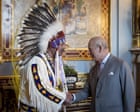
The room in Buckingham Palace didn’t feel like a seat of global power. It felt like a study. It smelled of old paper, floor wax, and the faint, sharp scent of Earl Grey. Across from Chief Desmond Bull of the Louis Bull Tribe, King Charles III sat not as a distant deity of the Commonwealth, but as a man burdened by the shifting tectonic plates of his own geography.
He wasn't looking at a map of the world. He was looking at Alberta.
When the Chief spoke about the growing whispers of sovereignty—the "Free Alberta" movement that has migrated from the fringes of talk radio to the mahogany desks of provincial power—the King didn’t just nod politely. He leaned in. His concern wasn't academic. It was visceral.
There is a specific kind of silence that follows the mention of a breaking union. It’s the silence of a house settling in the night, where you can’t tell if the wood is just cooling or if the foundation is actually starting to give way.
The Ghost of a Promise
To understand why a monarch in London cares about a political rift in the Canadian prairies, you have to look past the modern headlines of oil prices and carbon taxes. You have to look at the parchment.
For the First Nations of the plains, the relationship with the Crown isn't a sentimental holdover from a colonial era. It is a legal shield. When the Treaties were signed, they weren't agreements with a fleeting provincial government or even a federal administration in Ottawa. They were covenants made with the Crown itself.
Chief Bull described the King’s reaction as genuine worry. This makes sense. If Alberta were to actually sever its ties with Canada, the legal ripples would become a tsunami.
Consider a hypothetical homesteader on the outskirts of Red Deer. To him, "independence" sounds like a fresh start—a way to keep wealth within provincial borders and escape the regulatory grip of a federal government that he feels no longer speaks his language. He sees a future of autonomy.
But for the Indigenous communities whose land that homesteader lives upon, that same "independence" looks like a void. If the Canadian state fractures, what happens to the treaties? Does the provincial government inherit the obligations of the Crown? Or do those sacred promises simply evaporate into the dry prairie wind?
The King knows the answer is neither simple nor pretty.
A Family Feud with Global Stakes
The friction in Alberta isn't just about money, though money is the loud, angry drumbeat behind it all. It is about identity. It is the feeling of being the primary engine of a country’s economy while being treated like a difficult relative who isn't invited to the Christmas dinner.
Alberta produces the lion's share of Canada’s energy. It fills the coffers. Yet, many Albertans feel that the federal government in Ottawa views them as a climate-change villain rather than a partner. This resentment has curdled into a specific brand of separatism—one that the King recognized as a threat to the very idea of a unified Commonwealth.
During their forty-five-minute conversation, the King didn't just ask about the politics. He asked about the people. He wanted to know how the "Sovereignty Act" was being perceived on the ground, in the places where the pavement ends and the muskeg begins.
He understood something that many urban pundits miss: you cannot have a conversation about Western independence without involving the people who were there before the West was "won."
If Alberta moves toward a separate identity, it isn't just walking away from Ottawa. It is walking over a minefield of Indigenous rights that are baked into the very DNA of the land. The King’s concern is a recognition that the Crown is the glue. If you dissolve the glue, the whole model falls apart.
The Weight of the Ring
There is a heaviness to Charles’s reign that his mother, Elizabeth II, managed to float above through sheer longevity and silence. Charles does not have the luxury of silence. He has inherited a world that is actively questioning the utility of every institution it once held dear.
When Chief Bull spoke to the King about the "sovereignty" being claimed by the provincial government, he was highlighting a paradox. The province wants to be sovereign from Ottawa, but the First Nations are already sovereign through their relationship with the Crown.
It is a layering of authority that creates a complex, often confusing, legal reality.
Imagine two people claiming ownership of the same house, but they are using two different sets of laws to prove it. One points to a deed from fifty years ago; the other points to an ancestral right that predates the house itself. Now imagine a third party—the King—standing in the hallway, knowing that his name is on both documents.
The King’s interest in Alberta’s separatist movement isn't about meddling in Canadian politics. It is about stewardship. He is the guarantor of a system that is currently being stress-tested by populist anger and economic anxiety.
The Quiet Room and the Loud World
As the meeting in the Palace drew to a close, the contrast was stark. Outside, the world was rushing toward a fragmented future. Inside, a Chief and a King were trying to figure out how to keep the pieces together.
The Chief left the meeting with a sense that he had been heard. The King stayed behind with the knowledge that one of his most resource-rich realms is vibrating with a dangerous energy.
This isn't just a story about a "concerned monarch." It’s a story about the fragility of the social contract. It’s about the fact that even in 2026, the words written on sheepskin centuries ago still dictate the flow of billions of dollars and the fate of millions of people.
We often think of history as something that happened to us, a finished book on a shelf. But as the King looks toward the Canadian horizon, he sees that history is a living, breathing creature. It is hungry, it is restless, and in the heart of the Canadian West, it is starting to growl.
The map is changing. The question is whether the Crown can still hold the borders of the heart, or if the gravity of discontent has finally become too strong to resist.
The King watched the Chief depart, the weight of the crown perhaps feeling a little heavier than it did an hour before.