Zhang stands at the edge of the Amur River, where the wind doesn’t just blow; it bites. In the winter, the water turns into a jagged sheet of white marble, thick enough to support a semi-truck. In the summer, it is a grey, churning artery. For decades, the border between Heihe, China, and Blagoveshchensk, Russia, was a place of quiet, rhythmic stagnation. You could look across the water and see the other side, but the distance felt like a different century.
Now, that distance is being measured in minutes, tons, and digital ledger entries.
Zhang is a logistics fixer—a man who spends his days on a burner phone, trying to move Chinese-made heavy machinery into a Russian market that is starving for hardware. He is a small cog in a massive, grinding machine. Recently, his job has become a nightmare of bottlenecks.
The world changed. Global sanctions slammed doors shut in the West, and suddenly, every piece of cargo that used to travel via the Baltic Sea or through European land corridors is trying to squeeze through a few narrow openings in the Russian Far East. It is like trying to pour a gallon of water through a needle’s eye.
The Cost of the Wait
When we talk about "border infrastructure," the brain usually glazes over. It sounds like a line item in a government budget. Boring. Dry. Forgettable.
But for the driver sitting in a queue that stretches five miles into the frozen taiga, infrastructure is the difference between seeing his daughter's birthday and eating lukewarm instant noodles in a cabin that smells of diesel and unwashed socks.
The sanctions didn't just stop trade; they rerouted the world's gravity. Moscow is no longer looking toward Berlin or London. It is leaning its entire weight against the shoulder of Beijing. This shift has turned sleepy frontier towns into the most important economic junctions on the planet. Yet, the roads are cracking. The bridges are too few. The customs sheds are relics of a pre-digital age.
Zhang points to a line of yellow excavators idling near the wharf.
"Every hour they sit there, the profit evaporates," he says. "The bank in Moscow is screaming for the equipment. The factory in Changchun is screaming for the payment. And here we are, waiting for a crane that was built when Mao was still in office."
The Ambassador’s Urgent Telegram
This isn't just a local frustration. It has reached the highest levels of the diplomatic stratosphere. Zhang Hanhui, China’s top envoy to Moscow, recently made it clear: the status quo is a threat to the "limitless" partnership.
He didn't use flowery language. He spoke of the urgent need for "interconnectivity." In the world of high-stakes diplomacy, that is code for "build it faster or we both lose."
The logic is simple. Russia has the raw materials—the coal, the timber, the oil—that China’s industrial furnace craves. China has the microchips, the cars, and the construction equipment that Russia can no longer buy from the West. They are two halves of a whole, separated by a river and a mountain of red tape.
The problem is that you cannot trade a 21st-century volume of goods on 20th-century rails.
Consider the Trans-Siberian Railway. It is a legend of engineering, a steel ribbon that spans a continent. But legends don't handle surge capacity well. When the maritime routes were choked off by sanctions, the rail lines became the only game in town. The result was a systemic heart attack. Trains backed up. Containers were stranded in the middle of nowhere.
The envoy’s message was a wake-up call to the bureaucrats: The political will is there, but the concrete is missing.
Logistics as a Weapon of Survival
In the West, we often view trade as a convenience. We want our packages in two days. We want our shelves stocked. But in the current geopolitical climate between Moscow and Beijing, trade is an act of defiance. It is a survival strategy.
For Russia, building these bridges and expanding these ports is about proving that the "Maximum Pressure" campaign from Washington and Brussels has failed. For China, it is about securing a back door to energy and food that cannot be blocked by a naval blockade in the South China Sea.
There is a deep, historical irony here.
For centuries, these two giants eyed each other with suspicion across this same river. They fought skirmishes over tiny islands. They pointed nuclear missiles at one another. Now, the threat of external isolation has forced them into a marriage of necessity. But a marriage requires a shared home, and right now, the roof is leaking.
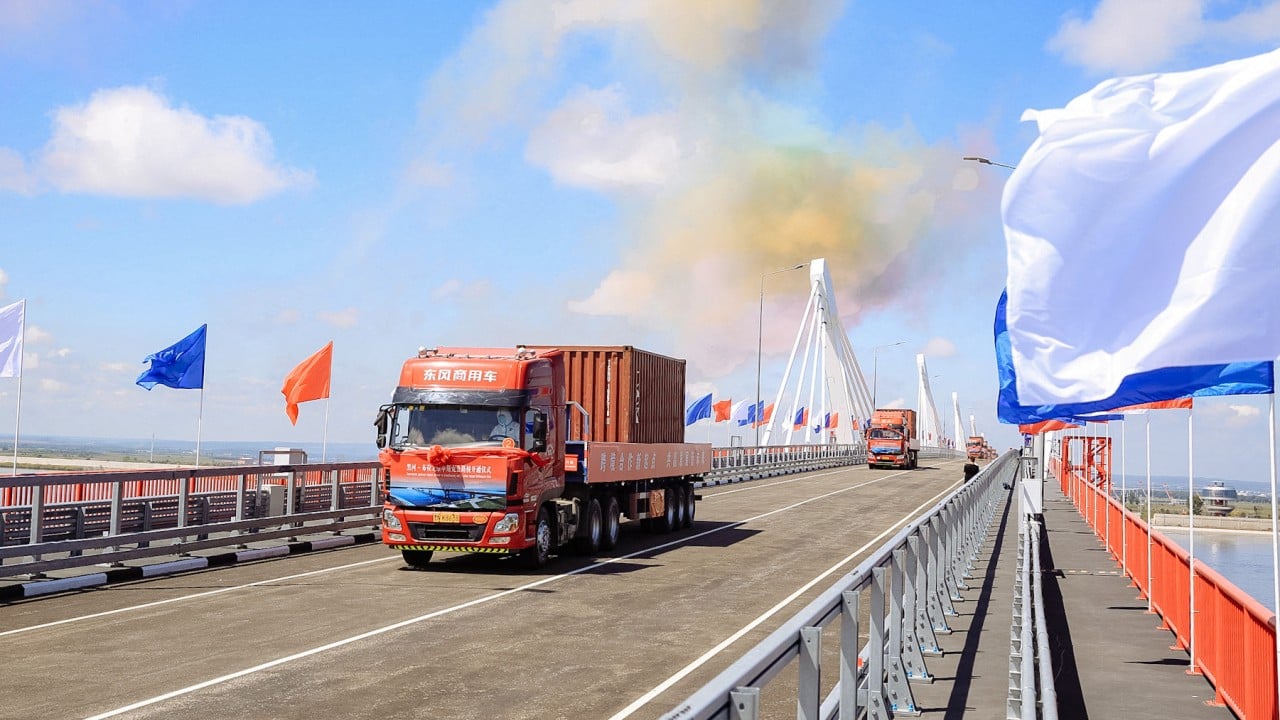
The new bridge at Heihe is a start. It’s a sleek, cable-stayed beauty that finally links the two banks. But a bridge is useless if the road leading to it is a mud track. A bridge is a bottleneck if the customs officers on either side are still using paper ledgers and manual stamps.
The Digital Fortress
Zhang, our logistics fixer, isn't just worried about the mud. He's worried about the money.
"The trucks can move, but the money is stuck in the sky," he explains.
This is the hidden layer of the infrastructure crisis. Sanctions have kicked Russian banks out of the SWIFT system. This means that even if a truck crosses the bridge, paying for the cargo is like trying to send a message via carrier pigeon in a thunderstorm.
The "infrastructure" the envoy is calling for isn't just made of steel and rebar. It’s made of code. It’s about building a financial plumbing system that doesn't rely on the US dollar or Western clearinghouses. They are trying to build a parallel reality—a world where the East can trade with the East without a single cent passing through a New York bank.
It is a monumental task. It requires synchronizing two of the world's most complex bureaucracies. It requires trust. And in the world of international trade, trust is a commodity as scarce as a warm day in a Siberian January.
The Human Geometry of the Border
The story of the China-Russia border is often told through numbers: billions of dollars in trade, millions of tons of grain, thousands of containers.
But look closer at the faces.
Look at the Russian shopkeeper in Blagoveshchensk who now stocks only Chinese brands of tea and electronics. Look at the Chinese engineer who has spent three years away from his family to oversee the construction of a railway spur in a place where the temperature drops to -40 degrees.
These people are the "interconnectivity." They are the ones living in the gap between the grand speeches and the reality of the dirt.
When the envoy speaks of "deepening cooperation," he is talking about the ability of these people to do their jobs without the constant fear of a sudden policy shift or a technical failure. He is talking about creating a flow that is so natural, it becomes invisible.
Right now, it is anything but invisible. It is loud. It is messy. It is the sound of tires spinning in the slush and the smell of exhaust hanging in the frozen air.
The Shifting Center of the World
For five hundred years, the Atlantic was the center of the world's commercial gravity. The great ports of London, Rotterdam, and New York dictated the pace of human progress.
What we are witnessing on the banks of the Amur River is the slow, agonizing movement of that gravity. It is shifting inland. It is shifting toward the Eurasian heartland.
If China and Russia succeed in building this "infrastructure of defiance," the maps in our children’s textbooks will look very different. The "Far East" will no longer be a periphery; it will be a hub. The remote forests of the Amur will be the new crossroads of empire.
But success is not guaranteed.
Geography is a stubborn opponent. The Amur River is wide. The distances are vast. The frost is deep. And the geopolitical pressure from the West is a constant, grinding force that seeks to find every crack in the foundation.
Zhang packs up his phone as the sun begins to dip below the horizon, casting a long, orange glow over the frozen river. A truck finally moves. The gate lifts. The air brakes hiss.
"They think they can stop us with papers and laws," Zhang says, nodding toward the western horizon. "But they don't understand. We have the river. We have the steel. We have the time."
The truck rolls onto the bridge, its headlights cutting through the gathering gloom. It is one truck. One load of steel. One small pulse in an awakening giant.
The invisible wall is still there, built of sanctions and suspicion. But bit by bit, the concrete is winning. The bridge is holding. And the world is turning, whether we are ready for its new orientation or not.
The wind picks up, howling across the ice, but the sound of the engine remains steady, a low, persistent growl that echoes all the way to Moscow and Beijing.