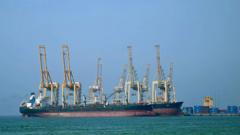
The maritime pulse of the world is currently flatlining at the Strait of Hormuz. After four days of a de facto Iranian blockade and a flurry of missile exchanges that have turned the Persian Gulf into a shooting gallery, President Donald Trump has made his move. He has ordered the United States Navy to begin escorting commercial oil tankers "if necessary" and, in a more unorthodox maneuver, directed the International Development Finance Corporation (DFC) to act as a high-stakes insurance agent for the global energy fleet.
The goal is clear. Washington wants to break the fever of $80-per-barrel oil and prevent a spike toward the triple digits. But for those of us who have watched these waters for decades, the rhetoric masks a far more complex and dangerous operational reality. This is not just about a "free flow of energy." It is an admission that the private sector has lost faith in the safety of the world’s most critical chokepoint, and the U.S. government is now forced to subsidize the risk of a regional war.
The Insurance Gap and the DFC Gamble
The most revealing part of the President's announcement wasn't the threat of naval steel. It was the directive to the DFC to provide "political risk insurance" at a "very reasonable price."
In the real world of global shipping, iron and gunpowder don't move the needles—actuaries do. Since the launch of Operation Epic Fury, the world’s major marine insurers, including names like Gard and Skuld, have effectively torn up their coverage for the Gulf. Without war-risk insurance, a $100 million tanker carrying $150 million in crude is a liability that no sane board of directors will authorize to sail.
By stepping in where the London market has stepped out, the administration is essentially putting the American taxpayer on the hook for every Iranian drone strike or limpet mine that finds a hull. It is a desperate measure to keep the "ghost fleet" of stranded tankers moving. However, government-backed insurance doesn't stop a ship from sinking. It only promises to pay for the wreckage.
The Escort Dilemma
The promise of naval escorts sounds like a return to the 1980s "Tanker War," but the math in 2026 is vastly different. The U.S. Navy currently maintains approximately 12 to 18 warships in the Fifth Fleet’s area of operations. On paper, that sounds formidable. In practice, it is a skeleton crew for the task at hand.
Most of these vessels, specifically the Arleigh Burke-class destroyers like the USS Frank E. Petersen Jr., are already burning through their vertical launch system (VLS) cells at an unsustainable rate. They are busy intercepting Iranian ballistic missiles and conducting retaliatory strikes against inland targets. Asking these same ships to babysit slow-moving commercial tankers through the 21-mile-wide "choke" of the Strait is an invitation to disaster.
A destroyer tethered to a tanker is a predictable target. Iran’s Islamic Revolutionary Guard Corps (IRGC) Navy doesn't fight fair. They use "swarm" tactics—hundreds of fast-attack boats, low-flying suicide drones, and shore-based anti-ship cruise missiles. For a naval commander, the choice becomes agonizing: do you use your limited interceptors to protect your own multi-billion dollar ship, or the commercial tanker carrying Qatari LNG?
The "If Necessary" Clause
Trump’s use of the phrase "if necessary" provides the White House with a convenient back door. It suggests that the mere threat of American intervention should be enough to pacify the IRGC. This overlooks the current internal temperature in Tehran. With the reported death of senior leadership and the destruction of nuclear facilities, the Iranian military is no longer playing a game of signaling. They are playing for survival.
The IRGC has already broadcast warnings via VHF radio: "No ship is allowed to pass." This isn't a suggestion. When five tankers have already been hit in 96 hours, including the Palau-flagged Skylight, the threshold for "necessary" has already been crossed. The delay in actual escort missions suggests a rift between the President’s Truth Social posts and the Pentagon’s assessment of its own magazine depth.
A Fragmented Coalition
In previous eras, the U.S. would lead a massive multinational coalition. Today, the world is watching with arms crossed. While Operation Prosperity Guardian in 2023 saw a broad (if shallow) list of partners, the current campaign against Iran is largely a U.S.-Israeli venture. European carriers like Hapag-Lloyd and CMA CGM have already instructed their fleets to seek shelter or reroute. They aren't waiting for a U.S. Navy escort that might arrive too late.
The strategic reality is that the U.S. Navy is being asked to do more with less. With 41% of the Navy’s mission-ready ships already tied up in the Middle East, the strain on the fleet is reaching a breaking point. We are watching a global superpower try to police a war zone with a tactical philosophy that assumes the enemy will eventually blink.
Iran isn't blinking. They are loading launchers.
The administration’s plan treats the Middle East crisis as a market fluctuation that can be stabilized with a few guarantees and a show of force. But the Strait of Hormuz isn't a market; it's a geographic reality. You cannot "insure" your way out of a blockade when the other side is willing to set the sea on fire. Unless the U.S. is prepared for a sustained, high-intensity naval campaign that goes far beyond "escorting," the free flow of energy will remain a campaign slogan rather than a maritime reality.
The tankers will stay at anchor, the insurance premiums will remain astronomical, and the Navy will continue to patrol a waterway that is effectively closed to everyone but the brave and the suicidal.


