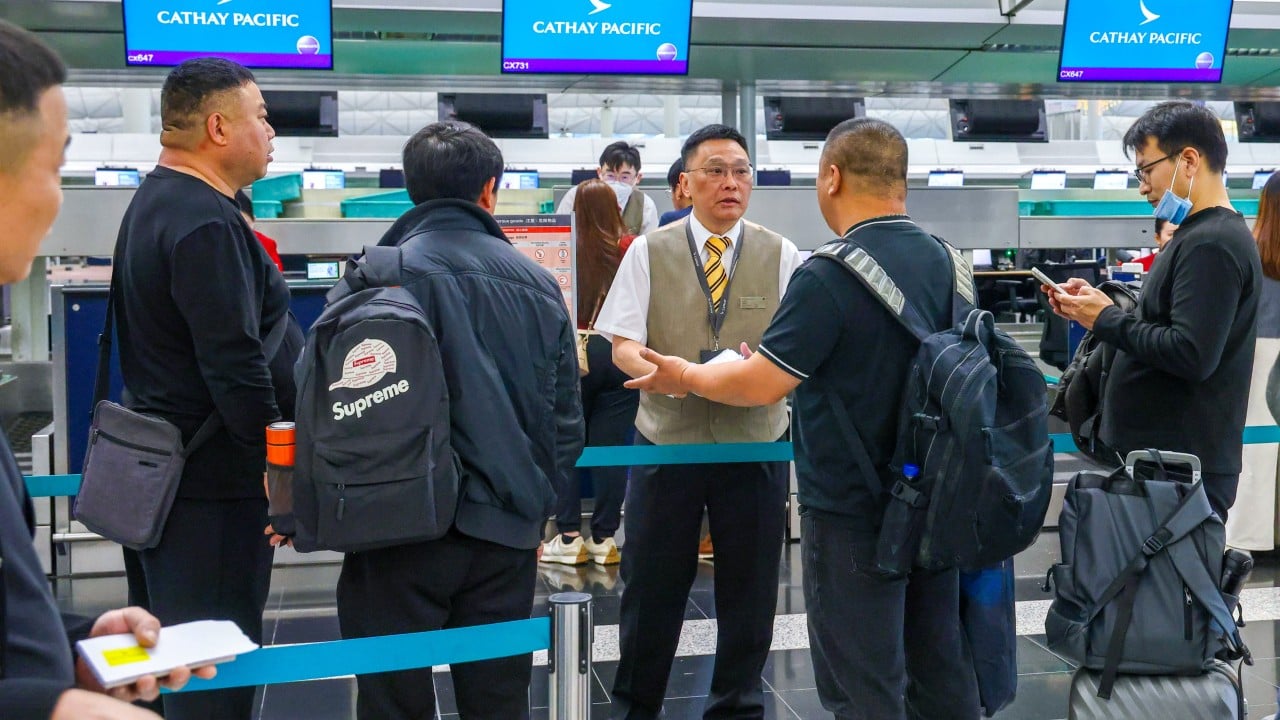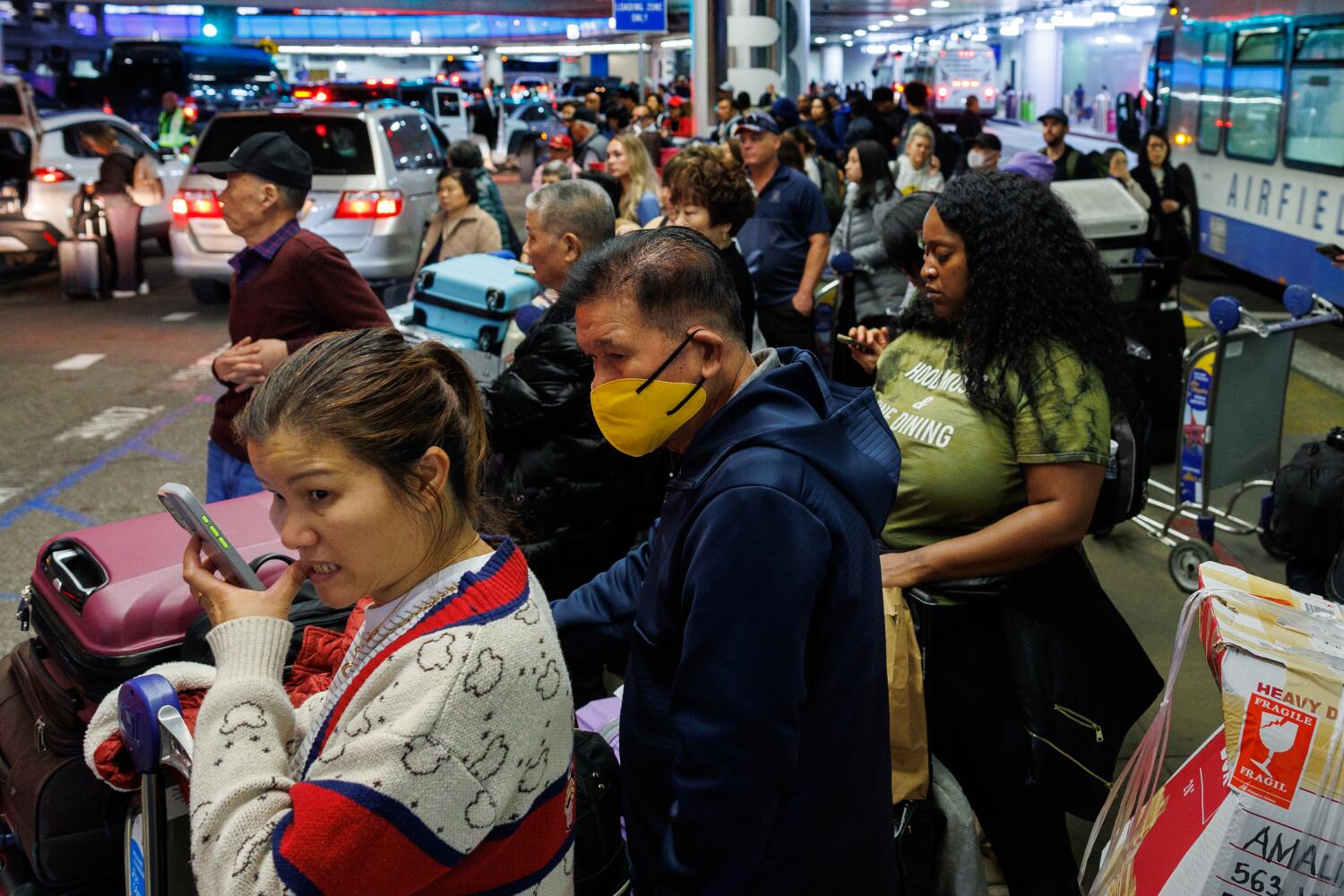
The departures board at LAX is a flickering wall of promises. Every few seconds, the mechanical hum of rotating pixels signals a dream realized or a journey begun. London. Tokyo. Sydney. But for those standing in the long, stagnant line at Terminal B, the board has become a graveyard of red text.
Canceled.
It is a word that carries the weight of a lead shutter. When the news broke that flights from Los Angeles to the Middle East were being scrubbed due to escalating conflict in the region, the headlines focused on the logistics. They spoke of "geopolitical instability," "closed airspace," and "risk mitigation." They calculated the cost in fuel and rerouted miles.
But logistics don't cry into their cell phones at 2:00 AM.
Consider a woman we will call Elena. She is real in every sense that matters—one of the hundreds of travelers currently adrift in the terminal. Elena isn't a diplomat. She isn't a military strategist. She is a daughter who hasn't seen her father in five years, carrying a suitcase filled with California almonds and heart medication. For her, the "closure of the Persian Gulf corridor" isn't a tactical map on a news screen. It is the sudden, violent erasure of a bridge she has been building for half a decade.
When a missile moves, a family freezes.
The Invisible Geometry of the Sky
We often treat the sky as an infinite, open sea. We imagine that a pilot can simply "go around" a problem, as if the atmosphere were a parking lot. The reality is far more rigid. The air above us is carved into invisible highways called jetways, and these roads are governed by a complex web of international law and physical safety.
When conflict erupts—specifically the recent volleys between regional powers in the Middle East—the sky doesn't just get "dangerous." It becomes a maze where the exits are being locked one by one. Airlines like Emirates, Qatar Airways, and Turkish Airlines don't cancel flights from LAX because they are timid. They do it because the math of a 15-hour flight no longer adds up.
If a primary corridor over Iraq or Iran is deemed a "no-go" zone by the FAA or international regulators, the detour isn't just a slight turn. It can add three, four, or five hours to a journey that is already pushing the limits of human endurance and fuel capacity. A Boeing 777-300ER carries a massive amount of weight, but it cannot carry an infinite supply of "what-ifs."
The safety of the passenger is the stated goal, but the secondary effect is a psychological strangulation. We are witnessing the shrinking of the map. After decades of "globalization" making the world feel like a small village, the sudden severing of these routes reminds us that we are still separated by vast, unforgiving distances that only remain traversable through a fragile, collective peace.
The Ghost in the Terminal
Walk through the Tom Bradley International Terminal right now and you will see a specific kind of haunting. It is the sight of people who are physically in Los Angeles but whose spirits are already 7,500 miles away.
There is a young man sitting on his duffel bag, staring at a static screen. He was supposed to be in Amman by tomorrow for a wedding. In his pocket is a ring he spent three years saving for. To the airline, he is a "disrupted passenger." To the insurance company, he is a "claim number." To himself, he is a man whose future has been put on hold by a drone strike he will never see, launched by people he will never meet.
This is the hidden cost of conflict. It isn't just the destruction of infrastructure in the blast zone; it is the collateral damage of human connection. Every canceled flight from LAX to Dubai or Doha is a thousand broken appointments. It is a business deal that would have funded a neighborhood. It is a surgery that won't happen. It is a goodbye that was never said.
The "standard" news report tells you that carriers are monitoring the situation. It tells you to check your app for updates. It misses the point entirely.
Why the "Simple" Fix Isn't Simple
You might ask: Why can’t they just fly north? Why not go over the pole?
The physics of ultra-long-haul travel are a brutal master. To fly from the West Coast of the United States to the heart of the Middle East requires a specific trajectory. When you remove a massive chunk of the map—like the airspace over Iran or the surrounding waters—you create a bottleneck.
Think of it like a bridge on a mountain road. If the bridge is out, you can't just "drive through the woods." You have to find another mountain pass. But everyone else is trying to use that same pass. Suddenly, the airspace over Azerbaijan or Saudi Arabia becomes a high-traffic nightmare.
Airlines must also consider "EDTO" (Extended Diversion Time Operations). This is a rule that dictates how far a twin-engine plane can be from a landing strip at any given time. If you are flying over a war zone or a vast desert where every nearby airport is closed due to the threat of incoming fire, you are legally not allowed to fly there. Not because the plane can’t make it, but because if one engine fails, there is nowhere safe to put the bird down.
The pilots understand this. The engineers understand this. But the passenger in seat 42K only knows that their screen says "Status: Canceled" and their heart is at a standstill.
The Weight of Uncertainty
The most agonizing part of this disruption isn't the delay itself. It is the open-ended nature of the "Why."
Unlike a blizzard in Chicago or a hurricane in Florida, a geopolitical conflict has no predictable "all-clear" signal. A storm passes. A war simmers. When an airline cancels its LAX-Middle East routes "until further notice," they are essentially telling the traveler that their life is now subject to the whims of generals and regional power brokers.
We have spent the last twenty years believing that distance was a solved problem. We thought that if we had the money and the passport, we could be anywhere in twenty-four hours. We forgot that the air we fly through is not ours. It is borrowed. It is a shared resource that requires a level of trust that is currently in short supply.
The frustration bubbling over at the ticket counters isn't just about lost luggage or missed connections. It is a collective realization of our own helplessness. We are sophisticated, technologically advanced beings who can stream high-definition video from the edge of space, yet we can be grounded by a single decision made in a bunker halfway across the planet.
The Silence After the Announcement
Late at night, when the crowds thin out and the janitors start their slow patrol of the terminal, the silence is deafening. The frantic energy of the afternoon—the shouting, the pleading with gate agents, the frantic typing on laptops—fades into a dull, aching quiet.
The people who are left are those who have nowhere else to go. They are the ones who traveled from San Diego, Santa Barbara, or Las Vegas just to get to this hub, only to find the door locked. They sleep on folded coats, their dreams interrupted by the occasional overhead page for a flight to a city that isn't their home.
We talk about "market volatility" and "oil prices." We discuss the "strategic depth" of certain nations. But we rarely discuss the tired eyes of a grandmother who just wanted to hold her newborn grandson.
The sky over the Middle East remains a patchwork of tension, a restricted zone where the silhouettes of fighter jets replace the blinking lights of commercial liners. Until those shadows lift, the departures board at LAX will continue its rhythmic, mechanical clicking.
For now, the world remains large. Too large.
Somewhere in the terminal, a phone pings with a notification of a refund. The money returns to the bank account, but the time is gone forever. The almonds in Elena's suitcase will grow stale. The wedding in Amman will proceed with an empty chair. The bridge is gone, and all that remains is the long, quiet wait for the world to remember how to let us pass.
The board flickers again. Another flight to another place. The travelers watch it, waiting for a word that doesn't come, while the 7000-mile ceiling hangs low over their heads.
The map has changed, and we are all just trying to find our way back onto it.